




February 15, 2016/FMI
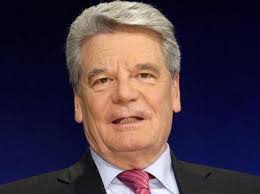
The President of Germany, Joachim Gauck has said that the Economic Community of West African States (ECOWAS) has in the 40 years of its existence, achieved a great deal through collaboration on transnational problems and alliance to external support, enabling the West African economy to strive.
He made the statement at the ECOWAS auditorium during his visit to the ECOWAS Secretariat in Asokoro, Abuja on Wednesday February 10, 2015. He also recalled that the European Union began as an economic community with a focus to create peace and prosperity through shared values, indicating that Europeans and West Africans have in common the experience that integration is always a gradual process, whether member states disagree or not on reforms.
According to him, democracy in various regions of the world has been open to challenges, thereby uniting the views of different regional organisations on the concept of values in the drive to sustain democratic systems. He further observed from his earlier visit to Lagos in Nigeria that some Nigerians full of energy and ideas have the zeal to change things in their country. Adding, many young, self-confident and open-minded women and men in Africa and large cities like Lagos, Abidjan, Dakar and Accra stand for economic strength, technological innovation, diverse cultural scenery and active civil society. They also represent the ambitious side of Africa which people in Germany and Europe ought to know about.
“I am thinking of the social, ethnic, religious and political conflicts that pose great challenges to Nigeria and other ECOWAS countries. I am thinking of terrorism, violence, flight, displacement, criminality, corruption, arbitrariness in the police and judiciary, and poorly functioning administrations. I know that you have had an agenda for many years and that you are working on your own solutions – West African solutions. Along with international aid workers, including aid workers from Germany, you successfully overcame the Ebola epidemic in West Africa,” he said.
“I firmly believe that the hard work involved in integration is well worthwhile. Regional responsibility and solidarity pay off. It is only by working together that one can pave the path to growth and development. The people in your countries are counting on you! Germany and Europe will continue to accompany you on your path. Your community’s success means a great deal to us Germans and Europeans.”
Joachim Gauck noted that since countries, economies, cultures and societies are moving ever closer together, regional crises and conflicts have often had a global impact. He also indicated that developing countries, newly industrialising countries and industrialised countries can only solve the many problems that are not confined to one country by working together. He explained that these issues pertain to the need to overcome climate change, conserve biodiversity, create peace and security, stating that countries involved in politics, business and society share responsibility for the future.
He affirmed that achieving the feat is not easy, therefore there is need to applaud the strides attained in uniting West Africa as evidenced by the determination of the people for their rights in Burkina Faso whose the high election turnout portrayed a people that want to have their say in the future of their country. “Overall, the democratic elections in West African countries have been encouraging signs,” he noted.
President Joachim Gauck was accompanied by the First Lady and Political Advisor to the President, Daniela Schadt; The State Secretary in the Office of the President, David Gill and the State Secretary in the Ministry of Foreign Affairs, Stefan Steinlein as well as the Ambassador of Germany to Nigeria, Michael Zenner and Interpreter, Perry Notbohm-Ruh.
In his welcome address earlier, the President of ECOWAS Commission, Kadre Desire Ouedraogo welcomed President Joachim Gauck and his wife, Daniela Schadt on behalf of ECOWAS institutions, expressing gratitude for the visit.
He informed him that ECOWAS is celebrating its 40th Anniversary and having made significant progress in consolidating regional integration processes at political, economic and institutional levels has endeavoured to consolidate on the regional market with the adoption of the ECOWAS Common External Tariff, the free movement of goods and persons with the abolition of visa for all ECOWAS citizens and adoption of the ECOWAS biometric card.
He identified other strides attained to include: the promotion of peace, good governance and democracy with the adoption of relevant protocols and tools on conflict prevention, management and resolution and the harmonisation of all sectoral policies in its priority areas such as agriculture, infrastructure, energy, education, youth, gender and institutional financial and administrative reforms to ensure more efficiency in the management of community activities.
The ECOWAS President commended the organisation’s founding fathers, saying the organisation’s achievements came to the fore through shared value for solidarity, strong political will and the determination of its leaders to attain success.
“ECOWAS is beholden to bilateral and multilateral partners for these achievements and recognises the support given by EU and it’s member states in the process. We express gratitude to your Excellency and to Chancellor Angel Merkel for the strong leadership and commitment to the development of Africa, in particular West Africa,” he stressed.
“While recognising ECOWAS achievements, the region still faces challenges from terrorism, good governance, human security and development, migrations, climate change and health systems. ECOWAS is working hard to address all these challenges for the deepening regional integration process aware that Germany has tremendously contributed to the EU integration process.”

