


31/8/2017/Cordros Research
Click here to download full PDF Copy of Report
Nigerian Capital Market
Equities
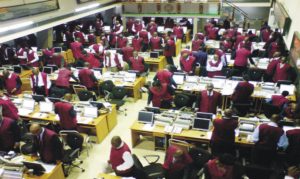
The equities market closed negative for the third consecutive week, with the ASI contracting further by 3.12% w/w as the bears dominated the bourse throughout the holiday-shortened week. As a result, the Month-to-Date (-0.95%) return turned negative, while Year-to-Date return moderated to 32.11%. The market had signaled some improvement towards the end of the previous week gaining 19 bps on Friday. The bears resurfaced on Monday and extended selloffs to today with declines across most sectors, the most notable being the Consumer Goods sector. Market performance during the week broadly reflected the absence of any fundamental driver, with the earnings season now over.
Performance across sectors was broadly bearish, with the Consumer Goods (-2.88% w/w) index recording the largest loss, following selloffs in GUINNESS (-7.36%), NB (-5.25%), and UNILEVER (-4.87%). Similarly, the Industrial Goods (-2.48% w/w) and Banking (-2.36% w/w) indices recorded negative returns, driven by profit-taking in the shares of DANGCEM (-5.09%) and UBA (-6.19%), respectively. On the other hand, the Insurance (+1.90%) index rebounded from last week’s loss to record the largest gain, following renewed interest in the shares of CONTINSURE (+13.95%), CUSTODYINS (+5.26%), and MANSARD (+2.63%). Following the gains recorded by TOTAL (+13.01%) and SEPLAT (+1.76%), the Oil & Gas (+0.29% w/w) index posted a positive return this week.
Market breadth remained repressed, closing negative with 46 losers (previously 38) – led by MOBIL (-14.25%) – and 18 gainers (previously 29) – led by CUTIX (+24.38%). In the same vein, total volume traded declined by 35.03%, with CUSTODYINS, SOVRENIMS, and FIDELITYBK accounting for 38.35% of total market volume. Total value of trades also contracted by 52.70%, with DANGCEM, NESTLE, and ZENITHBANK accounting for 42.46% of total value.
Global Equities
Again, the country indices within our coverage universe closed in the green, this time, with the exception of the Euro Stoxx 50. This week’s performance was driven by economic data, natural disaster, and geopolitical tension, currency swing, and government speech.
On Wall Street, appetite was buoyed by (1) strong economic reports including data showing that the U.S. economy expanded at a 3% pace in the second quarter – a faster pace than had originally been reported – impressive job data, and a jump in consumer spending, (2) President Donald Trump calling for an easy-to-understand tax code that would create jobs and higher wages. Meanwhile, the market was frazzled after a North Korean missile test over Japanese airspace, and investors grappled with the fallout from Hurricane Harvey. Interestingly however, shares of home-improvement retailers rose, on expectations they will benefit from demand for wood and other supplies from homeowners in the region that has been battered by hurricane Harvey. Overall, at the time of writing, the DJIA and S&P 500 advanced by 0.72% w/w and 0.60% w/w respectively. European stocks started the week on a bearish note, pressured by the euro hitting its highest level against the dollar in more than two years, and North Korea’s test-firing of a missile over Japan. Basic resources shares however benefitted from better-than-expected manufacturing data from China, although retail shares struggle after a warning from French supermarket chain Carrefour. The FTSE 100 (+0.29% w/w) remained resilient while the Euro Stoxx 50 (-0.13% w/w) declined.
Despite shedding weight amid (1) North Korea’s missile launch over Japan and (2) U.S. and European central bankers not providing fresh policy guidance, Asian stocks appreciated, as investors took cues from gains recorded in the U.S., with Japanese shares specifically riding on a stronger dollar. The CSI 300 and Nikkei 225 had posted weekly gains of 0.69% and 1.00% at the time of writing.
Fixed Income
Money Market
The overnight money market rate contracted by 416 bps to 8.42%, following a reported increase in system liquidity to N250.41 billion against last week’s close of N24.43 billion. The improved liquidity was driven by sizeable inflow from maturing OMO bills valued at N101.23 billion. In a bid to tighten system liquidity, the apex bank offered a total of N180.63 billion and sold bills worth N18.63 billion as investors demanded higher yields. Specifically, sales were only recorded on the longer tenured bills at a stop rate of 17.95%.The overnight market rate was mixed during the week, rising as high as 26.75% on Monday while contracting to 8.42% today.
Treasury Bills
At this week’s primary market auction, the apex bank fully allotted treasury bills worth N193.14 billion, comprising –N26.14 billion of the 91-day, N30 billion of the 182-day, and N137 billion of the 364-day bills at respective stop rates of 13.30%, 17.36%, and 18.52%. Activity in the secondary market was bullish, reflective of the relative improvement in system liquidity this week, with average yield contracting by 24 bps to 18.31%, from 18.55% last week. Yields at the short (-50 bps), mid (-12 bps) and long (-13 bps) ends of the curve contracted to 17.67%, 18.82%, and 18.41%, respectively, as investors demanded for the 21-SEP-2017 (-432 bps), 1-MARCH-2018(-63 bps), and 8-MARCH-2018 (-63 bps) respectively.
Bond
Conversely, proceedings in the bond market were bearish, with average yield expanding marginally by 1bp to 16.67% against 16.66% last week. Yield at the short (-18 bps) and long (-3 bps) ends contracted to 16.67% and 16.64%, respectively, as investors renewed their interest in the 29-JUNE-2019 (-23 bps) and 18-APRIL-2037 (-3 bps) bonds. Conversely, yield at the mid (+35 bps) end of the curve expanded to 16.79% as investors sold off the 15-JULY-2021 (+26 bps) bond.
Foreign Exchange
During the week, the CBN injected USD250 million in the interbank market – comprising USD100 million in the wholesale window, USD85 million in the SMEs window, and USD65 million in the invisibles segment. This brings the apex bank’s total intervention in the month to USD1.20 billion, which we believe is sustainable for the rest of the year with the continuous accretion to the foreign reserves – appreciated 41 bps w/w to USD31.81 billion. Accordingly, in the interbank market, the NGN strengthened against all currencies we track – USD (+0.56%), GBP (+0.18%), and EUR (+0.76%) – to close at respective rates of N355.49, N462.27, and N425.49. In the same vein, the 3 months, 6 months and 12 months forward contracts appreciated by 0.27%, 0.34% and 0.10% to N377.4, N397.17 and N435.18, respectively. However, in the parallel market, activity was slightly mixed as the USD/NGN (+1.35%) and GBP (+2.09%) strengthened to N365 and N468, respectively, while the EUR/NGN closed flat at N432. The USD/NGN depreciated 0.02% and 0.03% to N305.85 and N359.67, at the CBN spot and I&E FX Window, respectively.
OUTLOOK
Equities: Activity in the market this week broadly reflects the absence of fundamental stimulus with Q2 earnings season now over. We believe market movement will be driven by developments in the local economy, with intense volatility in the weeks ahead.
Money Market: In the coming week, N135.41 billion worth of OMO bills will be maturing. However, we expect the continued OMO auction, in addition to FX sales by the apex bank to pressure system liquidity. Thus, we look for an expansion in rates in the coming week.
T-Bills: We expect average yield to trend northward in the coming week, as decline in system liquidity constrains demand.
Bond: We expect a mixed trading session in the coming week, with selloffs outweighing demand on expected tight system liquidity.
Currency: With the improved intervention by the apex bank across FX windows, we expect further appreciation of the naira in the interbank market, while trading within its current band in the I&E FX window and CBN spot.
Click here to download full PDF Copy of Report

