


June 24, 2021/WebTV (digitalTV powered by Proshare)
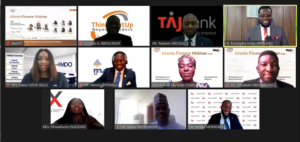
On June 16, 2021, WebTV (digitalTV powered by Proshare) hosted the maiden edition of its Islamic Finance Webinar Series focused on discussing Investment Opportunities in Nigeria’s Non-Interest Capital Market (NICM). The event which was sponsored by Proshare and NASFAT had in attendance Mr. AbdulKadir Abbas, Head of Department, Securities and Investment Services, SEC Nigeria as the Keynote Speaker; as well as other key dignitaries and market players from the non-interest capital market ecosystem inclusive of Mrs. Adaze Uzor-Kalu, Head, External Relations, FMDQ Group; Mr. Akeem Oyewale, CEO, Marble Capital Limited; Mr. Tesleem Akosile, Team Lead, Shariah Non-Compliant Risk, TAJ Bank; Mrs. Oluwafunto Olasemo, Vice President, Financial Markets, AFEX; Mr. Ndako Mijindadi, Head, Investment & Research, Lotus Capital Limited and Dr. Mustapha Ishaq Akinlaso as the Moderator.
Speaking about the importance of the event, Mrs Bukola Akinyele-Yisau, the WebTV Islamic Finance Weekly Programme Anchor, explained that the webinar was an avenue to enlighten corporate entities and investors about non-interest finance opportunities in Nigeria’s capital market, while addressing salient issues affecting the growth of the market. She further added that it was essential to enable stakeholders deliberate on avenues to synergize efforts to grow the industry.
In his keynote address, Mr. Abbas asserted that the Securities and Exchange Commission (SEC) is committed to the growth and development of Nigeria’s non-interest Capital Market, adding that the growth of the non-interest capital market (NICM) in the country has been fueled by the increase in Sukuk bond issuances amidst a growing appetite for the instrument by local investors.
Speaking on the Capital Market Master Plan (2015-2025) developed by the Securities and Exchange Commission, Nigeria he said the goal is to ensure that the NICM sub-sector represent 25% of the overall market capitalization by 2025, while Sukuks will represent 15% of total debt issuances outstanding by 2025. He noted that in 2004, SEC joined the IOSCO joint committee on the Islamic Capital Market in Nigeria which led to the development of several initiatives to deepen the market.
In addition, Mr. Abbas stated that the commission will continue to promote enabling regulations to make Nigeria the regional hub for non-interest finance in Africa through collaboration with market stakeholders to introduce regulations that provide level playing field for all participants, fostering partnerships for capacity building to build an innovative and efficient NICM, embracing digitalization to support innovative products and developing a dynamic fair, transparent and an efficient market where investors and businesses in Africa could invest and raise sharia-compliant capital.
On his part, Mr. Akosile, who represented the Managing Director of TajBank, Mr. Norfadelizan Abdulrahman, said there are enormous opportunities for non-interest banks to collaborate with other stakeholders to build a vibrant Islamic finance ecosystem.
He identified areas like wealth management as a means to develop products for high-net-worth individuals (HNIs) and other classes of citizens, thereby driving financial inclusion and economic empowerment.
Mrs. Adaeze Uzor-Kalu, Head, External Affairs, FMDQ Group in her presentation said Nigeria was one of the pioneering nations that has established an Islamic Finance Regulatory framework in the West African Region. From the debt market perspective, she said the total global Sukuk market had reached $715.2bn in Q1, 2021 which was 3% higher than in Q4, 2020. In terms of prospects for developing Islamic finance through the Debt Capital Market, she highlighted the following areas that the Nigerian debt capital market needs to learn from and explore:
- The need for a standardized and robust regulatory framework for Sukuk issuance
- The need for government and regulatory incentives to drive participation in the Islamic Finance sector.
- The need for heightened awareness on Islamic Finance and build capacity in key institutions.
- The need for increased primary markets issuances of Sukuks and Islamic commercial papers
- Enhancing liquidity through a two-way quote system.
In all, she stated that Islamic financing is critical to improving financial inclusion as it takes account of Shariah-complaint market players. Also, Islamic finance and ESG finance are complementary capital-raising and investment approaches as they both consider their impact on society, welfare of people and the environment.
In his presentation, Mr. Akeem Oyewale, outlined the various segments that non-interest finance products could be developed and adopted such as Sukuk (Islamic Bonds), Commodities, Islamic Unit Trusts, Islamic Derivatives, Equities, Mutual Funds, and Islamic Exchange Traded Funds. Oyewale also described the Lotus Index as an enabler for investors seeking Halal-compliant stocks in the capital market, while expatiating on the various benefits of Islamic Capital Markets such as offering muslims, and other ethically conscious investors the opportunity to invest without comprising their convictions; promoting social justice and offering highly competitive returns for individuals, while serving as a good source of funds for asset growth for organisations and reducing economic disparity, enhancing ethics, equity and property rights, and aiding the achievement of the 2030 gender for sustainable development for governments.
The Vice President, Financial Markets, AFEX Nigeria, Mrs. Oluwafunto Oluwasemo, identified trade finance, inventory/working capital finance, commodity trading, and production finance as aspects in the commodities market that Islamic Finance can support.
She pointed to other investment opportunities for Islamic finance such as Sharia Asset-Backed Commodities Products (ABCP), Exchange Traded Commodities (ETC), Input finance, and Spot contracts.
In the area of investment through Islamic finance products and Index, Mr. Ndako Mujindadi, Head, Investment and Research, Lotus Capital informed participants that the total market cap of Shariah-compliant stocks stood at roughly N11.3trn. Concerning benefits that could be derived from Islamic finance instruments, Mr. Mujindadi believed sectors like Real Estate and Healthcare could be funded by non-interest Islamic finance assets.
All the panelists agreed that the non-interest finance (Islamic Finance) industry is poised for growth and should be well utilizes by entities including individuals, organisations and governments).
Other highlights of the webinar were the participation and deliberations around the polls shared on Islamic finance literacy, ownership of non-interest bank accounts, and the understanding of the benefits of investing in non-interest finance products; the question and answer session and a giveaway of access to Non-Interest Investment Products managed by Lotus Capital and Marble Capital to two participants (one from India and another from Nigeria).
The Webinar which had attendees from other parts of the world including Poland, Malaysia and India featured a presentation by Alh. Ayodeji Abdulrauf, the 1st Vice President of NASFAT who elaborated on what NASFAT stands for and how it supports the Islamic finance market through access to Islamic Finance scholars who are knowledgeable about the industry and can facilitate the development of Shariah Compliant products. He also mentioned that NASFAT has been involved in socially impactful projects through collaborations in activities focused on Health, Education Livelihood and Dawah (Islamic Evangelism). He also called on the Islamic Finance community to support the development of its University – Fountain University, which requires more infrastructure to enhance the learning environment for students.
To Watch the FULL VIDEO of the Webinar Click HERE www.proshareng.com/webtvchannels/Banking/4220/1
For feedbacks and enquiries, kindly contact Bukola via Bukola.akinyele@proshareng.com

