



January 19, 2022/CSL Research
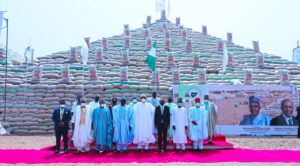
Recently, President Muhammadu Buhari unveiled 1 million bags of rice paddy stacked as 13 pyramids in Abuja to reduce the country’s import bill by conserving the limited foreign exchange reserves. The President disclosed that one of the continued government’s interventions vis-a-vis the apex bank’s Anchor Borrowers Programme (ABP) in supporting smallholder farmers drove the increase in rice production. He also admonished agricultural commodity associations yet to participate in the ABP to set the ball rolling to support the nation’s food sufficiency target.
Still, for a better understanding of the rice production value chain, the apex bank offtakes the bags of rice paddy from the smallholder farmers which is then sold to rice millers at a reduced price, leading to the eventual sale of processed rice to the public. Also at the event was the CBN governor, Godwin Emefiele, who noted that the rice production in the country rose to 9.0m MT in 2021 from 5.4m MT in 2015. However, official statistics from the USDA puts Nigeria’s milled rice production at 5.0m MT as of October 2021, while total consumption and residual was 6.95m MT as of October 2021.
Since 2011, the government has been making substantial efforts to encourage the domestic cultivation of rice aimed at completely eliminating inports using incentives such as subsidized loans, cheap fertilizers, free farm land, and tax rebates. However, as local production still lagged rising demand, smuggled imports have been left to plug the shortfall. Meanwhile, in the last one year, the government has buckled up in improving local production evidenced by the launching of rice pyramids in states such as Kebbi and Ekiti.
The efforts at improving rice production in the country is laudable as it gradually closes the supply gap in the country. As of October 2021, Nigeria produced 5.0m tons of milled rice, which, if compared to the total consumption of 6.95m tons within the same period, still shows a supply gap. Beyond that, while the government improves production, we think the government needs to pay more attention to the rice value chain in the country as many consumers complain about the poor processing of local rice which still makes consumers resort to imported rice.


