

September 8, 2022/FBNQuest Research
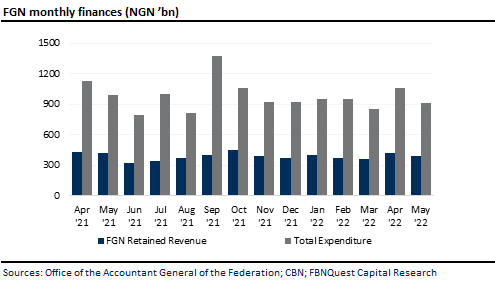
The CBN’s monthly economic report for May ‘22 shows that the federal government of Nigeria’s (FGN) fiscal operations resulted in a smaller fiscal deficit of -NGN524bn in May compared with -NGN643bn the previous month. The deficit was also slightly below the -NGN570bn recorded in the year-earlier period. The lower deficit in May was underpinned by a marked m/m reduction in the FGN’s total expenditure. The data are provisional and as such are subject to revisions.
The FGN’s retained revenue amounted to NGN388bn, or -7% lower m/m, and -8% below the corresponding period of 2021. It was also -57% lower than the monthly budget benchmark.
The principal driver of the revenue underperformance m/m were lower revenue receipts from the federation account, largely on account of a -36% m/m decrease in non-oil revenue.
The marked shortfall in revenue relative to the pro-rata monthly benchmark reflects the FG’s optimistic revenue projections, for which a pattern has emerged over the years.
Total expenditure fell by -14% m/m and -8% y/y to NGN912bn, and considerably below the NGN1.4trn benchmark.
In line with historical trends, capital expenditure was the major loser. It declined to NGN140bn compared with NGN262bn the previous month, and far below the NGN456bn monthly budgeted target.
On a cumulative basis, the data shows total revenue and expenditure of NGN1.95trn and NGN4.73trn respectively for the January to May period, and a fiscal deficit of -NGN2.8trn, which implies an annualised fiscal deficit-to-GDP ratio of 3.9%, based on 2021 GDP figures.
The data, provided by the CBN, differ slightly from those provided by the Budget Office of the Federation, with the latter providing a fuller picture. For instance, the (annualised) fiscal deficit implied in a recent presentation by the minister of finance for the January to April period was a much larger fiscal deficit of 5.1% of 2021 GDP.
Given the revenue underperformance, the near-term fiscal outlook remains challenging. According to the finance minister, the 2023 fiscal deficit is projected to rise to between 5.0% and 5.5% of GDP from c.4% envisaged in the 2022 budget depending on which of the two expenditure scenarios are adopted under the Medium-Term Expenditure Framework.