


June 27, 2023/CSL Research
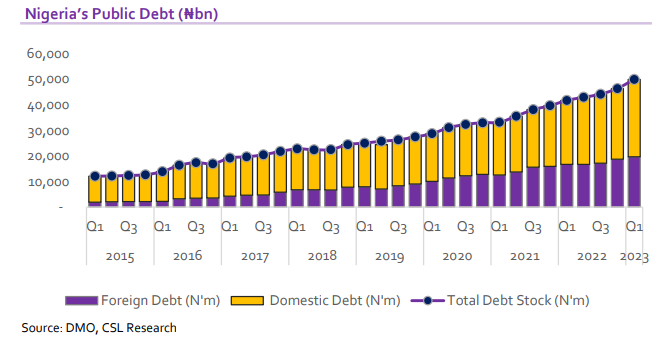
Based on the recent data released by the Debt Management Office (DMO), Nigeria’s total foreign debt for the period ending 31 March 31st, 2023, rose to N49.85 trillion (US$108.30 billion) from N46.25 trillion as of 21 December 2022. CBN official exchange rate of N460.35/US$1 as at 31 March 2023 was used in converting the domestic debts to dollars. The figure consists of the domestic and external total debt stocks of the federal government and the sub-national governments (36 state governments and the Federal Capital Territory). The country’s public debt increased by N3trn between January and March 2023. The DMO noted that the recently securitized ways and means exposure of N22.719 trillion will be included in the total public debt stock from June 2023.
In March 2023, total external borrowing grew to N19.64tn from N18.70trn recorded in December 2022. Total domestic debt stock also grew from N27.55trn in December 2022 to N30.21trn in March 2023. We believe new borrowings by the FGN and sub-national governments, primarily to fund budget deficits and execute projects were the main drivers of the growth seen. We note that the domestic debt stock is made up of major instruments like FGN bonds, treasury bills, treasury bonds, savings bonds, FGN Sukuk, promissory notes, and green bonds.
Nigeria’s total public debt has been growing significantly in in recent years. In the last eight years, it has surged by 266.96%. The government’s fiscal deficit for 2023 is the highest on record, as revenue mobilization remains largely constrained and spending continues to jump. Debt servicing and personnel costs remain a huge part of total spending. We note that following the Naira devaluation, the size of the country’s external debt stock in Naira terms will rise significantly. Considering current economic realities, which do not seem set to improve in the short term, we would likely continue to see debt levels increase as revenue generation remains constrained.