

July 3, 2023/FBNQuest
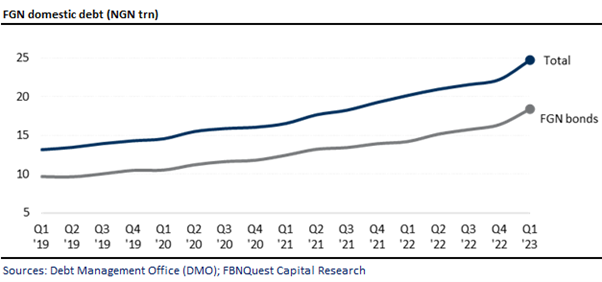
According to the most recent data on public debt published by the Debt Management Office (DMO), FGN’s total domestic debt stock increased by 11% q/q and 23% y/y to NGN24.7trn as at Q1 ’23. The FGN’s share of domestic debt represents c.82% of the nation’s total public debt stock of NGN30.2trn, with the balance comprising domestic debt of the state governments and the federal capital territory (FCT). However, it’s important to note that the FGN’s total domestic debt stock does not include the NGN22.7trn ways and means (W&M) advances obtained from the CBN. The National Assembly approved the securitization of these advances in May 2023. The DMO has disclosed that the W&M advances will be included in the FGN’s debt profile starting from Q2 ’23.
The FGN’s total domestic debt share is equivalent to roughly 12.4% of 2022 GDP. However, this figure rises to 23.8% of 2022 GDP if the W&M advances are included.
A breakdown of public debt shows that the share of FGN bonds which typically dominates the overall debt mix rose to 74.5% from 73.9% in Q4 ’22, and 70.7% in Q1 ‘22.
The increase can be attributed to the DMO’s record-breaking debt issuance this year. The agency achieved remarkable sales of nearly NGN2trn worth of FGN bonds in Q1 ’23, compared with NGN764bn in Q1 ’22, which was also a record at the time.
The DMO has had to ramp-up FGN bond sales at its monthly auctions in order to raise financing to plug the FGN’s projected record fiscal deficit of around NGN10.8trn, about NGN7.0trn of which is to be funded by domestic borrowings.
Turning back to the breakdown of the FGN’s domestic debt split, Nigerian Treasury bills (NTBs) accounted for the second largest share at 19.1% of the total.
The debt stock balance also includes smaller amounts in Treasury bonds, savings bonds, Sukuks, and promissory notes, totalling NGN1.6trn, which represents 6.4% of the total.
The DMO’s 2022 debt sustainability analysis has highlighted the limited fiscal space and reduced capacity for further debt accumulation due to the inclusion of the W&M advances in the public debt. It also emphasized the necessity for enhanced revenue generation.
The recent removal of fuel subsidies and the unification of exchange rates marks a significant step towards enhancing government revenue and expanding the fiscal space.