


July 14, 2023/FBNQuest
Data from the National Insurance Commission (NAICOM) reveals that the gross premium income of the insurance sector increased by 18% y/y and 36% q/q to NGN726bn in Q4 ’22. The total premium income is made up of income generated from both the life insurance and non-life insurance businesses. The insurance sector has remained resilient, despite the several macroeconomic headwinds faced by the sector, such as high inflation, rising cost of energy and fx shortages.
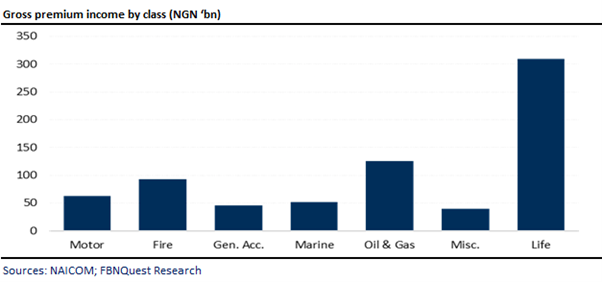
In line with recent trends, the non-life business continued its market dominance with a 57% share of the total premium income. In terms of value, the total premium income generated by the segment increased 17% y/y and 34% q/q to NGN417bn.
The data shows that the Oil and gas sector was the leading contributor to the non-life business with a share of 30%. It was followed by Fire insurance and Motor insurance with respective shares of 22% and 15%. Marine & Aviation, General Accidents and others also contributed around 12%, 11% and 10% of the total premium income, respectively.
The life insurance business which accounted for 43% of the total premium income generated by the sector, increased by NGN48bn or (+18% y/y) to NGN309bn in Q4 ’22.
On a cumulative basis, the total premium income generated by the insurance sector increased by 16% y/y to NGN1.9trn in FY ’22.
In terms of the sector’s market size, its total assets stood at NGN2.3trn, implying an increase of 2% q/q and 4% y/y.
With respect to market size distribution of total assets, non-life business assets stood at NGN1.1trn, while life insurance assets amounted to NGN1.2trn.
Based on the data, the sector’s insurance claims rose by 31% q/q to NGN318bn during the quarter, accounting for 44% of the total premium income.
Although the country’s insurance sector has continued to deliver double-digit growth, there is significant ground to cover with respect to providing insurance coverage to individuals, particularly those in the informal sector.