

August 4, 2023/FBNQuest
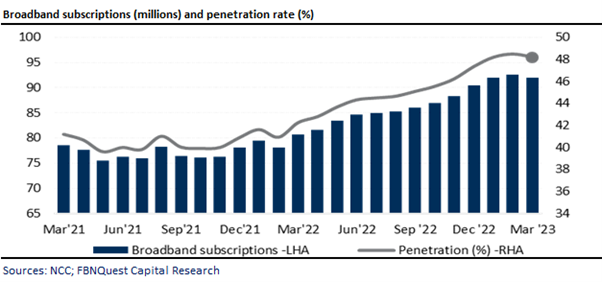
Our chart below, produced using data provided by the Nigerian Communications Commission (NCC), shows a slight decline in Nigeria’s broadband internet connections in Mar ’23. The latest m/m decline breaks an upward trend that began in Mar ’22. According to NCC, mobile broadband accounts for a dominant share (over 99%) of Nigeria’s broadband connections due to the ease and relatively low cost of acquiring mobile lines. As such, the drop in broadband connections broadly mirrors the downward trend in mobile internet subscriptions, and by extension, the number of active mobile lines.
We see from the data that total broadband connections declined by -1% m/m but increased by +14% y/y to about 92 million as at end-Mar ’23.
This implies that broadband penetration fell slightly to 48.2% from 48.5% during the same period.
Despite the slight drop in Mar ’23, we have witnessed significant progress in internet access in Nigeria in recent years, most of which can be attributed to substantial investments by network providers.
To put this into context, the broadband penetration rate peaked at about c.48.5% in February ’23 from c.20% in 2017.
These investments have been motivated by the federal government’s implementation of the National Broadband Plan (NBP 2020-2025).
Some of the key targets of the national broadband plan are to achieve 90% population coverage and a penetration rate of 70% by 2025.
Although appreciable progress has been made in enhancing broadband penetration, there remains significant ground to cover regarding policy implementation targets with respect to coverage, cost, and speed of broadband connection.
While the broadband target seems ambitious, we anticipate that the ongoing investments by network operators, particularly the continuous rollout of 5G technology will accelerate broadband penetration growth.