August 23, 2023/FBNQuest Research
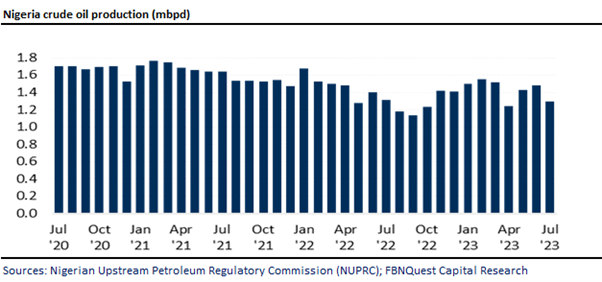
The most recent data from the Nigerian Upstream Petroleum Regulatory Commission (NUPRC) reveals that Nigeria’s daily production of crude oil fell to 1.29 million barrels per day (mbpd) in Jul ’23 from 1.48mbpd the previous month. The figure includes condensates of almost 0.2mbpd. Excluding condensates, the nation’s total crude oil output was just a little under 1.1mbpd compared with nearly 1.3mbpd in Jun ’23. This decrease is the sharpest since April 2023, when total crude oil and condensate production dropped to 1.25 mbpd. .
The m/m fall in crude oil output in July was mostly due to a significant reduction in crude oil evacuation through the Forcados oil terminal following pipeline repairs after the discovery of oil leaks.
Consequently, crude oil output (ex- condensates) through the terminal fell to approximately 0.09mbpd compared with 0.24mbpd in the prior month.
Additional contributing factors to the decline include minor output reductions of 18kbpd, 9kbpd, and 7kbpd at the Bonny, Escravos, and Qua Iboe terminals, respectively.
On a positive note, crude oil evacuations from Forcados are expected to ramp up to optimal levels of 0.23mbpd, following the recent completion of repairs by Shell Petroleum Development Company.
Ongoing challenges with crude oil theft and illegal connections to key trunk pipelines have prevented the country’s oil output from reaching potential levels of around 1.7 to 1.8mbpd.
Although the oil economy’s contribution to GDP has averaged 6.2% over the past eight quarters, its importance to the economy is underscored by the fact that it accounts for roughly 90% of merchandise export earnings.
Its significance is even more pronounced due to the prevailing fx liquidity challenges. These challenges have restricted access to fx on the official fx market, leading to the resurgence of a substantial premium of the parallel market rate over the official market rate.
Although the NNPC recently announced a USD3bn emergency loan from the Afrexim Bank to help stabilize the naira, this is only a short-term fix.
A lasting solution requires the fiscal authorities to address some of the concerns of the oil-producing communities in order to achieve optimal crude oil output.