August 31, 2023/FBNQuest
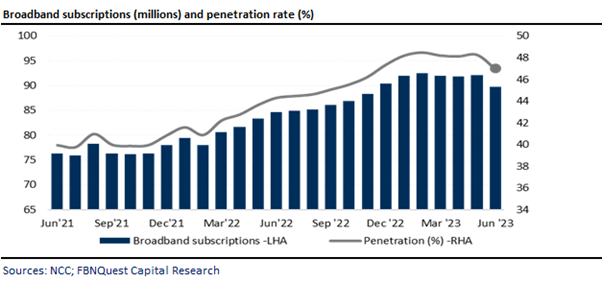
According to the most recent data from the Nigerian Communications Commission (NCC), Nigeria’s broadband internet connections declined by -3% m/m to 89.7 million in Jun ’23. Broadband connections have maintained a downward trajectory since Feb’23, apart from the slight increase in May ’23. Nigeria’s broadband connections typically mirror mobile broadband accounts. As such, the downward trend in broadband subscriptions can be linked to the sustained decline in the number of active mobile lines.
The modest drop in broadband connections resulted in a decrease in broadband penetration to 47.0%, its lowest level since Nov ’22. This compares with 48.3% recorded in the previous month.
Another factor which may be responsible for the steady decline in broadband connections is the high cost associated with accessing internet services.
In our view, the rising inflationary trend is a strain on consumers’ wallets, which makes it increasingly difficult for individuals to afford internet subscription packages.
The recent decline in broadband penetration derails strides towards achieving a 2023 broadband penetration rate of 50% as specified in the objectives of the National Broadband Plan (NBP 2020-2025).
The plan also has an ambitious broadband penetration target of 70% and seeks to achieve a population coverage of 90% by 2025.
It is important to note that considerable progress has been made with respect to internet coverage in recent years, which can be attributed to network infrastructure investments across the country by telecoms operators.
However, recent data suggests that some of the progress attained toward the coverage target has been reversed in recent months.
Given the current state of broadband connections, there remains significant ground to cover in achieving these policy targets.