September 7, 2023/FBNQuest Research
Today, we turn our attention to Nigeria’s agricultural sector, which according to the latest national accounts, published by the National Bureau of Statistics (NBS), contributed c.23.0% to Nigeria’s GDP in Q2 ’23, slightly higher than the c.21.6% it contributed in the previous quarter.
However, the sector faces numerous challenges which continue to limit agricultural productivity. Some of these challenges are well-known structural supply-side issues, such as rising insecurity in food-producing states, infrastructure deficits, inadequate storage facilities, and logistical challenges, amongst others. These limitations have led to the country’s dependency on imported food items.
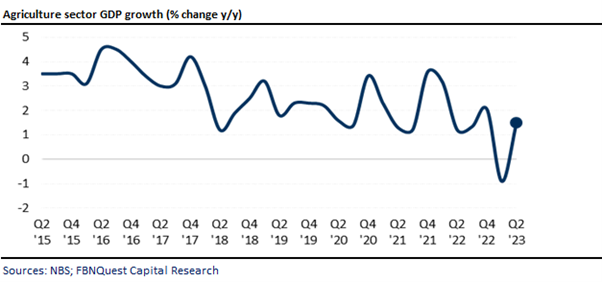
Notably, the agricultural sector grew by +1.50% y/y in Q2 ’23 (vs. -0.90% and +1.20% respectively). However, the sector’s performance is disappointing, considering various government initiatives and programmes aimed at boosting productivity in the sector.
Some of these initiatives include the Anchor Borrowers’ Programme (ABP), the Commercial Agriculture Credit Scheme (CACS), the Agriculture Promotion Policy (APP), and Export Promotion Incentives, amongst others.
Crop production, which accounted for 90% of the sector’s GDP, expanded by 1.82% y/y in Q2 ’23. This compares with 1.93% and 1.54% in Q1 ’23 and Q2 ’22 respectively.
In line with previous governments, the new administration has highlighted the agricultural sector as one of its key priorities, noting the urgent need to fix the nation’s food supply crisis.
To drive its commitment to tackling food shortages in the country, President Bola Tinubu recently declared a state of emergency on the nation’s food security. Additionally, the President also revealed policies and initiatives that will be implemented to revamp Nigeria’s agricultural sector and attain food self-sufficiency.
Most importantly, the administration seeks to address farmers’ limited access to land by providing 500,00 hectares of land to boost agricultural output.
If these highlighted structural issues can be addressed, the government’s interventions in the sector have the potential to improve the sector’s productivity and reduce Nigeria’s food import costs.