




September 12, 2023/Coronation Research
Does the price of Airtel Africa have any significance for the Naira/US dollar exchange rate? It may be a fanciful thought, but the sophisticated trades between Airtel Africa’s NGX Exchange listing and its London listing point to convergence, at least in the short term, between the arbitrage price and the parallel exchange rate.
Airtel Africa and the Naira/US$ Rate
Nigeria is several months into its currency reform and the picture, so far, is frustrating. The I&E Window rate is N736.6/US$1 and the parallel exchange is close to N930.0/US$1, the gap having widened to 26.3% over the past few weeks. Yet one small part of the foreign exchange market appears to be reaching a consensus, at least in the short term, with the implied exchange rate between Airtel Africa’s shares traded in Nigeria and those traded in London reaching N876.8/US$1, very close to the parallel market rate.
This was not always so. For much of 2022 and early 2023 the two exchange rates were out of kilter – by a wide margin. In late September 2022, the implied exchange rate was nearly N1,400/US$1, while as recently as last March it reached N1,210/US$1. This meant that some traders were prepared to buy Airtel Africa shares on the NGX Exchange at N1,548.7/s, have them cancelled and reissued in London, and sell them GBP1.05/s, paying N1,480.6 per Pound Sterling or N1,210.3 per US dollar. It was an expensive way of purchasing US dollars when the parallel exchange rate was N746.0/US$1, though it had the advantage of delivering funds to the recipient via the London Stock Exchange.
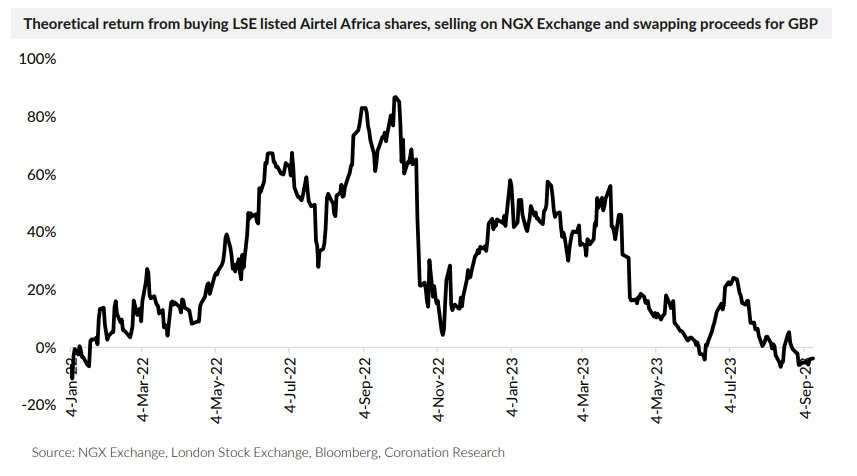
Of course, with such a huge difference between the arbitrage rate (N1,210/US$1) and parallel rate (N746.0/US$1) it also made sense to do the trade in reverse. Arbitrageurs would buy London-listed shares, have them cancelled in London and reissued in Lagos, then sell the NGX Exchange listed shares for Naira and trade the proceeds via the parallel market for pounds or US dollars. With the share prices so far apart, such trades could realise a return in excess of 40.0%
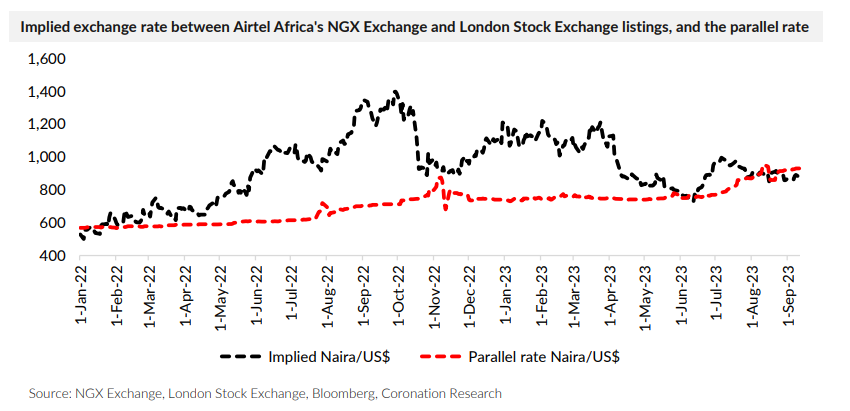
Clearly, more participants are aware of this trade, and more participants have made themselves capable of doing it, than before. The arbitrage opportunity has all but disappeared. This implies that a large number of professional investors are involved and it is interesting that the implied rate is close to the parallel exchange rate. It is a feature of exchange rates settling down, in our view, that different arbitrage and parallel rates eventually converge.
This is not to say that either the parallel exchange or the exchange rate implied by Airtel Africa’s two listings have any bearing on where the Naira/US dollar rate will settle. Nor do they have any bearing on the Naira/US dollar rate in the I&E Window; nor do they have any bearing on the fair value of Naira/US dollar. But it may be a sign that the currency markets are becoming a little more efficient than they were.
FX
Last week, the exchange rate at the Investors and Exporters Window (I&E Window) gained 0.51% to close at N736.62/US$1. In the parallel (or street) market, the Naira slipped by 1.40% to close at N930.00/US$1. Currently, the gap between the I&E Window and the parallel market stands at 26.25%. The gross foreign exchange (FX) reserves of the Central Bank of Nigeria (CBN) slipped by 0.54% to US$33.39bn.
Notwithstanding the current pressure on the Naira, we maintain that the reform of the foreign currency market will lead to improvements in FX liquidity in the medium term.
Bonds & T-bills
Last week, the secondary market for T-bills closed bearish with average yields increasing by 37bps to 7.93% pa. Average yields along the T-bill curve increased: at the short end (51bps to 4.24%); long-end (27bps to 9.84%) while the mid-end yield declined (86bps to 5.91%). In the primary T-bill auction, which took place mid-week, the CBN offered N214.74bn (US$165.69m) with a total subscription of N875.74bn. The bid to offer ratio was 4.08x compared with 5.09x for the auction held at the end of August. However, the average yield at auction fell by 104bps to 8.02% per annum.
The secondary market for FGN bonds moved in the same direction as the secondary market for T-bills. The average yield increased by 37bps to 7.93%. Average yields along the FGN bond yield curve rose: at the short end (51bps to 4.24%) and long end (27bps to 9.84%) while the mid-end declined (86bps to 5.91%).
We maintain our view that the market may be heading towards a new period of elevated rates in coming auctions. Our expectation is hinged on persistently low system liquidity and investors bidding for elevated rates. If another OMO auction takes place, as expected, it would further impact rates.
Oil
Last week, trading in oil was still going strong as Brent Crude closed 2.37% higher to settle at US$90.65/bbl. Year-to-date, it is up by 5.52% and has been trading at an average of US$80.98/bbl year-to-date, 18.27% lower than the average of US$99.09/bbl in 2022.
Supply-side factors continue to dominate crude price movements. The Organization of the Petroleum Exporting Countries (OPEC) and its ally Russia (hence OPEC+) will most likely maintain their production limits going into the fourth quarter.
We maintain our view that, for most of the year, prices are likely to remain above the US$75.00/bbl mark set in Nigeria’s government budget
Equities
Last week, the NGX All-Share Index closed higher, increasing by 0.91% to settle at 68,143.34 points. Its year-to-date return rose to 32.96%. Oando (+38.74%), PZ Cussons (+14.29%), and FCMB Group (+13.33%) closed positive while Nigerian Breweries (- 2.31%), Nestle Nigeria (-2.27%), and Dangote Cement (-1.30%) closed negative. Performances across the NGX sub-indices were mostly positive as the NGX Banking (+5.55%) topped the list, followed by NGX Consumer Goods (+2.24%), NGX Pension (+1.49%), and NGX 30 (+0.78%) indices closing green. On the other hand, the NGX Insurance (-2.94%), NGX Industrial Goods (-0.49%) and the NGX Oil/Gas (-0.12%) indices closed in the red.
Model Equity Portfolio
Last week the Model Equity Portfolio rose by 0.93% compared with a rise in the NGX All-Share Index of 0.91%, outperforming it by 2bps. Year-to-date it has risen by 35.34% compared with a rise of 32.96% in the NGX All-Share Index, outperforming it by 238bps
Last week there were strong gains from our notional positions BUA Foods and the banks, where we remain overweight. Over the coming week we will continue to reduce our overweight positions in the banks, with a view to taking them to a neutral position in aggregate. We will also conduct a review of our positions in the major index weights and align our positions with them.

