September 22, 2023/FBNQuest Research
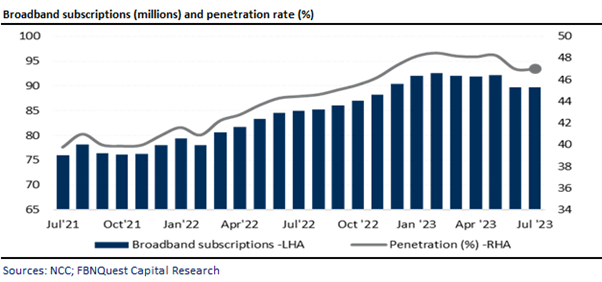
According to the latest data on broadband connections provided by the Nigerian Communication Commission (NCC), Nigeria’s broadband internet subscription was flat m/m at 89.7 million in Jul ’23, indicating a broadband penetration rate of 47.0%. However, on a y/y basis, it shows a modest growth of +6% y/y. The flattish m/m growth breaks a downward trend that began in March ’23, except for a slight increase (+0.3% m/m) in May ’23.
According to the NCC, mobile internet connection accounts for over 99% of Nigeria’s broadband base, mainly due to the ease and low cost of acquiring mobile lines.
Consequently, the flattish m/m growth in broadband subscriptions can be partly attributed to the slight pick-up in the number of active mobile lines in July ’23.
One of the objectives of NCC, as stated in the Strategic Vision Plan (2023 – 2025) report is to facilitate the deployment of fixed-line infrastructure to boost extensive broadband services in Nigeria.
Additionally, it also plans to ensure internet services are readily accessible and affordable for consumers.
The Commission’s drive to deepen broadband penetration in the country is a positive development, given its potential effects on economic activity, particularly in sectors like e-commerce and fintech.
For context, the International Telecommunication Union (ITU) estimates that a 10% increase in broadband penetration will lead to additional GDP growth of 2.0% and 1.8% for low- and middle-income countries, respectively.
However, multiple headwinds, such as, the foreign exchange scarcity, downward adjustment of the naira, and security concerns, especially in rural areas poses significant risks to the actualization of the commission’s broadband objective.
Moving forward, we expect that the continuous roll-out of 5G networks by telecom operators will accelerate broadband penetration in the country.