September 25, 2023/FBNQuest Research
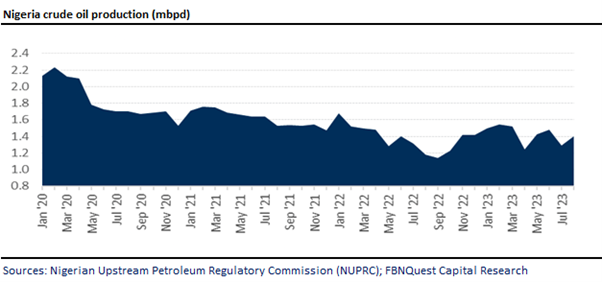
According to the most recent data from the Nigerian Upstream Petroleum Regulatory Commission (NUPRC), Nigeria’s daily production of crude oil increased to 1.16 million barrels per day (mbpd) in Aug ’23 from c.1.08 mbpd the previous month. Including condensates of 0.24mbpd, the daily production of liquids reached 1.4mbpd in August, up from 1.29mbpd the previous month. Despite the gains, the modest recovery of oil production (ex-condensates) in August remains well below historical levels, which averaged 1.7mbpd prior to Q2 ’20.
The m/m increase in crude oil production was mainly due to a rise in oil evacuation through the Bonny, Forcados, and Qua Iboe export terminals.
More specifically, crude oil evacuation (ex-condensates) through Bonny increased by 0.04mbpd to c.0.12mbpd compared with the previous month.
Additionally, oil evacuation through Forcados and Qua Iboe export terminals increased by 0.03mbpd and 0.02mpbd to 0.12mbpd and 0.15mbpd respectively.
Notably, all three export terminals are running well below optimal evacuation levels of around 0.24mbpd for Bonny, and 0.23mbpd, and 0.22mbpd for Forcados, and Qua Iboe respectively.
The suboptimal crude oil production and evacuation levels can be attributed to significant challenges associated with crude oil theft and illegal connections to key trunk pipelines.
These illegal activities have prevented the country’s oil output from reaching potential levels of around 1.7 to 1.8 mbpd.
Despite the recent surge in crude oil prices, with Brent crude rallying by almost 29% over the past three months, Nigeria has not been able to reap the benefits of high crude oil prices.
The oil sector’s low productivity has caused severe economic setbacks, including minimal foreign exchange (fx) accumulation in the official reserves, fx liquidity challenges, and a sharp depreciation of the naira on the parallel market.
We reiterate that the medium-term solution to Nigeria’s fx challenge hinges on tackling oil sector leakages and addressing the concerns of oil-producing communities in order to optimise crude oil production.