
October 4, 2023/FBNQuest Research
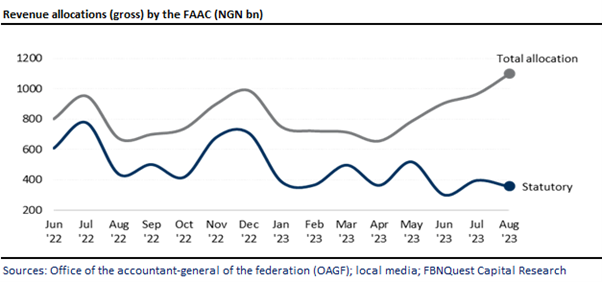
The gross monthly distribution by the Federation Account Allocation Committee (FAAC) to the three tiers of the government amounted to NGN1.1trn (USD1.4bn) in September (from August revenue). September’s FAAC disbursement represents an increase of almost NGN134bn compared with the previous month’s payout. As illustrated by our chart, it is also the highest distribution (in local currency terms) to the constituent governments for as far back as we can track. The increase relative to the previous month was mainly due to revenue augmentation of NGN177bn augmentation.
The revenue disbursed also featured an exchange rate gain of NGN230bn, around -19% lower compared with the previous month.
With regards to other disbursements, statutory revenue declined c.-10% m/m to NGN357bn and accounted for 32% of the total distributed sum.
In contrast, revenue from VAT increased by 18% m/m to NGN322bn, while electronic money transfer fees increased by 10% m/m to NGN14bn.
Of the distributed sum, the federal government’s (FG) share increased by NGN58bn (+15%) m/m to NGN431bn.
Additionally, disbursements to the 36 states of the federation (ex.13% derivation for oil-producing states), and local governments increased by NGN51bn and NGN37bn to NGN362bn and NGN266bn, respectively.
Although the downward adjustment to the naira exchange rate has resulted in an expansion of FAAC disbursements, we expect some of the gains to be partially eroded by an escalation in the government’s wage bill following salary negotiations with the trade and labour unions.
Furthermore, the likely reinstatement of fuel subsidies, spurred by the surge in crude oil prices to over USD90/barrel in recent months, is expected to further constrain the fiscal space.
An additional source of concern is the anticipated increase in debt service costs in local currency terms due to the securitization of NGN22.7trn in ways and means, along with the expansion of external debt in local currency terms to NGN33.2trn from NGN19.6trn in Q1 ’23.