

October 24, 2023/FBNQuest Research
Today, we focus our attention on Nigeria’s agricultural trade patterns from the National Bureau of Statistics (NBS) Q2 ‘23 report on foreign trade. As expected, crude oil accounted for 76% of Nigeria’s merchandise export trade in Q2 ’23. Other oil products and agricultural goods contributed c.10.6% and c.4.0% of exports. The balance of 9.4% comprised of manufactured goods, raw materials, solid minerals, and energy products.
Although the value of agricultural exports was flat q/q to NGN280.9bn in Q2 ‘23, it almost doubled on a y/y basis.
According to the data, top exports products were cashew nuts (shelled), cashew nuts in shell, and sesamum seeds with values of NGN57.8bn, NGN56.0bn, NGN38.3bn respectively.
Additionally, the data shows that most of Nigeria’s agricultural exports were shipped to Asia (NGN202.6bn), Europe (NGN55.5bn) and America (14.8bn).
With respect to imports, agricultural goods constituted c.7.9% of total imports, slightly lower than the c.8.5% it accounted for in the previous quarter.
In absolute terms, the value of agricultural imports declined by -2% y/y and -4% q/q to NGN454.9bn.
The top import destinations were Europe, Asia, America with values of NGN241bn, NGN100.0bn and NGN86.0bn respectively.
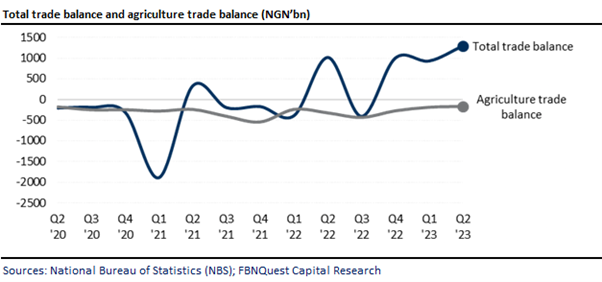
However, Nigeria remains a net-importer of agricultural goods with an agricultural trade deficit of about NGN174.0bn.
Cumulatively, the country’s agricultural trade deficit declined by -35% y/y to -NGN366bn in H1 ’23.
Despite government’s efforts to increase local food production with a view to achieving self-sufficiency, the data indicates that the nation still has a long way to go before it achieves this objective.