October 23, 2023/FBNQuest Research
The most recent electricity sector report from the National Bureau of Statistics (NBS) reveals a 13% y/y increase in total electricity billed by the nation’s distribution companies (Discos) to 5,909.8 gigawatt hours (GWh) in Q2 ’23. Overall, the total electricity billed by the Discos increased by 5% y/y to 11,761.7Gwh in H1 ‘23. Annualising the H1 ’23 figure implies a total power consumption through the national grid of approximately 23,523 GWh. This figure compares unfavorably with those of some other African peers such as South Africa, Egypt, and Algeria, with annual electricity consumption of 191,440 GWh, 168,323 GWh, and 68,663 GWh, respectively, according to data from the US Energy Information Administration (EIA).
In contrast to the lagged but more comprehensive data from the Nigerian Electricity Regulatory Commission (NERC), the NBS data lacks details such as the total energy received by Discos from the transmission grid.
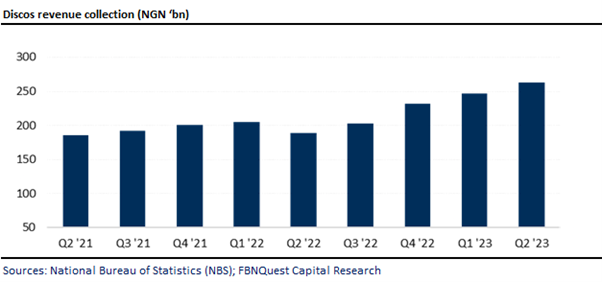
Further illustrating the point, total revenue collection by the Discos increased 40% y/y to NGN263bn in Q2 ’23. However, the data fails to show the total amount invoiced by the Discos. Notably, collections have consistently fallen far short of the invoiced amount. Historically, collection efficiency has consistently averaged around 70%.
Underscoring the revenue collection challenges, out of 11.5 million registered customers by the Discos as of Q2 ‘23, only 5.5 million were metered, leading to reliance on estimated bills for the remaining 6.0 million customers.
Over the years, the federal government has subsidized the sector to cover the revenue deficit from non-cost-reflective tariffs and the revenue shortfalls of the Discos.
The federal government is committed to phasing out subsidies within the sector. However, similar to the persistence observed in the removal of petrol subsidies, this process has proven to be challenging.
Recognising the need for substantial investments to address Nigeria’s energy deficit, we commend the administration for its initial steps in reforming the sector and empowering investors and state governments for electricity generation, transmission, and distribution.
Addressing Nigeria’s power deficit has the potential to boost economic productivity, with a multiplier effect on GDP growth.