
October 31, 2023/FBNQuest Research
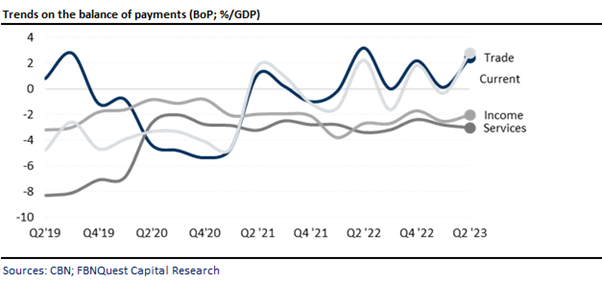
We see from the Central Bank of Nigeria’s (CBN) most recent Quarterly Statistical Bulletin (QSB) that Nigeria’s current account improved to a surplus of USD2.9bn in Q2 ’23, up from a revised deficit of -USD412.5m in Q1 ’23. The figure represents 2.8% of GDP. A notable observation is that the balance of payments (BOP) data for Q2 ’23 has significant revisions compared to the initial data reported for Q1 ’23. To further illustrate, the latest BOP data shows a current account deficit of -0.4% of GDP in Q1 ’23, compared with a previous surplus of 2.2%.
Consequently, the current account deficit in Q1 ’23 marks a deviation from the trend of two consecutive quarters of current account surpluses indicated by the previous Q1 ‘23 data series.
Returning to the Q2 data, Nigeria’s current account typically mirrors the trade account. As such, the positive outturn on the current account was primarily driven by a marked improvement in the trade account to a net surplus of USD2.5bn from a lower net surplus of USD132.7m in Q1 ’23.
The surplus on the trade account was underpinned by a significant -20% q/q decrease in the value of imports to USD11.4bn.
The marked q/q decline in imported items can be attributed to the ongoing shortage of foreign exchange (fx) supply caused by the low accretion of fx into the economy.
The income and services account recorded lower net deficits of -USD2.1bn and -USD3.1bn compared with -USD2.9bn and USD3.2bn in Q1 ’23, respectively.
A net surplus of about USD6bn recorded in net current transfers was another contributing factor to the positive outcome on the current account.
Additionally, the current transfers account has consistently posted net surpluses since Q1 ’14, which have mostly been driven by net workers’ remittances.
Looking forward, we anticipate that the current account surplus will persist due to a contraction in imports stemming from FX liquidity challenges.