November 1, 2023/Fitch Ratings
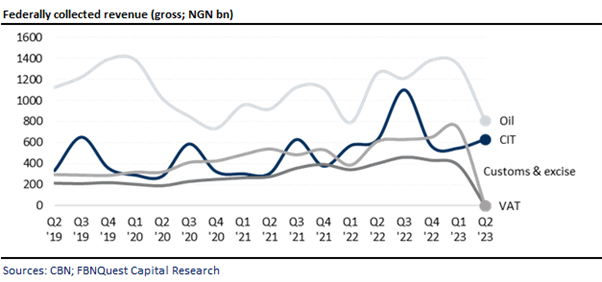
According to the Central Bank of Nigeria’s (CBN) most recent Quarterly Statistical Bulletin, gross federally collected revenue fell by -16% q/q and -13% y/y to NGN2.5trn in Q2 ’23. The government’s revenue receipts have now declined for three consecutive quarters. The consistent decline in federal gross revenue reflects the continued tightness of the government’s fiscal space. The decrease in revenue receipts during the quarter was primarily attributable to lower oil revenue. The revenue collection from oil decreased sharply by -40% q/q and -36% y/y to NGN809.0bn.
Notably, the gross receipts from oil during this period are the lowest since Q1 ’22, when it earned c.NGN790bn.
Underpinning the drop in oil revenue were declines of 36% q/q and 45% q/q in revenues from crude oil royalties, oil & gas sales, and petroleum profit tax (PPT). Similar to the previous quarter, there were no receipts from crude oil and gas sales.
The sustained underperformance of oil revenue reflects the dwindling productivity of the oil sector due to issues related to oil theft, pipeline vandalism and evacuation challenges in oil-producing communities.
Non-oil revenue, which accounted for 68% of the total revenue, increased by a modest 2% q/q and 5% y/y to NGN1.7trn.
Apart from the non-oil revenue receipt of NGN2.2trn in Q3 ’22, the revenue collected from non-oil sources during the quarter represents the highest revenue for as far back as we can track.
Underscoring the slight q/q improvement in non-oil revenue was a 15% q/q increase in taxes collected by the Federal Inland Revenue Service (FIRS) to NGN630.4bn.
In contrast, revenue received from customs and excise duties, and value-added taxes (VAT) declined by -2% and 5% to NGN381.9bn and NGN706.7bn, respectively.
Despite the recent increase in oil prices, the Nigerian economy will continue to face fiscal pressure due to low oil production and the reinstatement of fuel subsidies.