
November 7, 2023/FBNQuest Research
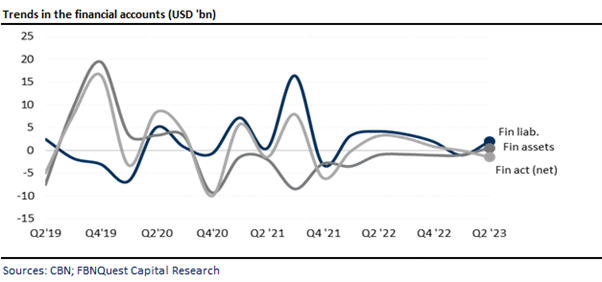
Today, we turn our attention to the financial accounts, in concluding our discussion on the Central Bank of Nigeria’s (CBN) recently released data on the balance of payments (BOP). As shown in our chart below, the financial account improved to a net surplus of USD1.4bn in Q2 ’23. This compares to a revised net surplus of USD44.0m recorded in the previous quarter. In standardised terms, the net surplus on the financial account in Q2 ’23 is equivalent to 1.4% of GDP.
The marked improvement in the net surplus in the financial account was driven by an inflow of USD2.0bn from financial liabilities, compared with an outflow of -USD996.7m recorded in the previous quarter.
Underscoring the higher net surplus in financial liabilities was an inflow of almost USD2.0bn from portfolio investments. The inflow, combined with an outflow of USD47m, resulted in a net portfolio inflow of USD1.9bn.
Investments in debt securities were the largest source of contribution to the total portfolio inflow, amounting to USD1.2bn in Q2 ’23. This marks a significant improvement compared to the negative position of -USD1.7bn it registered in Q1 ’23.
Equity securities also recorded an inflow of USD776m during the quarter, a 51% q/q increase over the USD513m recorded in the previous quarter.
Notably, the inflow from foreign investors into the equity markets during the quarter is the highest in the past ten quarters.
In contrast, other investments recorded a net outflow of USD2.1bn during the quarter, much higher than the net outflow of USD562m in Q1 ’23.
The data also shows that direct investments registered a net outflow of -USD74m compared with a net inflow of USD107m in Q1 ’23.
The CBN has begun the settlement of the backlog of outstanding fx swaps with commercial banks, estimated at around USD6.7bn.
We believe that the recent action by the CBN aimed at clearing the fx backlog is a step in the right direction towards restoring foreign investors’ confidence and stabilizing the naira in the medium term.