November 10, 2023/FBNQuest
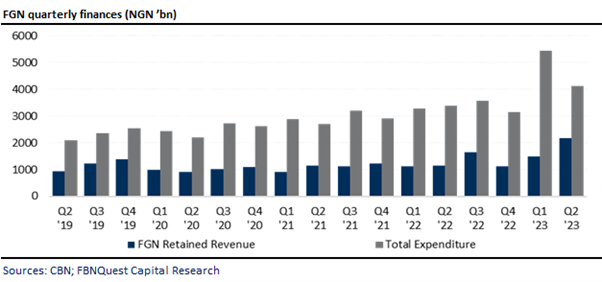
We see from the Central Bank of Nigeria’s (CBN) Quarterly Statistical Bulletin for Q2 ’23 that the fiscal operations of the Federal Government of Nigeria (FGN) resulted in a lower fiscal deficit of -NGN2.0trn, compared with -NGN3.9trn and -NGN2.2trn in the previous quarter and the corresponding quarter of 2022, respectively. The data is published by the CBN but sourced from the Office of the Accountant-General of the Federation. It is worth mentioning that the data is provisional and subject to revisions in subsequent publications.
The primary source of the marked q/q reduction in the FGN’s fiscal deficit was a -27% q/q decline in the government’s total expenditure to NGN4.1trn. However, on a y/y basis, total expenditure increased by +21%.
Although recurrent expenditure fell by -15% q/q to NGN3.2trn, the q/q reduction in total expenditure was mostly driven by a -51% decrease in capital expenditure to NGN877.9bn.
On a more positive note, the FGN’s retained revenue for Q2 ‘23 rose by 22% y/y to NGN2.2trn. However, the q/q increase was modest compared to the y/y increase of 86%.
The marked improvement in the government’s revenue can be attributed to higher revenue contribution from the Federation account.
Moving forward, we expect further expansion in the revenue allocation from the federation account due to the downward adjustment of the naira exchange rate.
On a cumulative basis, the FGN’s fiscal operations between Jan-Jun ’23 resulted in total revenues and expenditures of NGN3.9trn and NGN9.7trn respectively, implying a deficit of NGN5.8trn.
These figures track far behind the forecast revenue and expenditure of NGN5.6trn and NGN10.9trn, implied by the 2023 budget over the same period.
However, the fiscal deficit of -NGN5.8trn is only slightly higher than the -NGN5.4trn deficit projected by the budget for the 6M ’23 period.