


November 23, 2023/FBNQuest Research
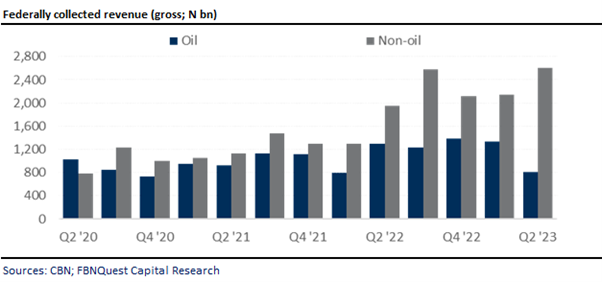
The CBN’s most recent Quarterly economic report shows that Nigeria’s gross federally collected revenue declined modestly by -2% q/q to NGN3.4trn in Q2 ’23. However, on a y/y basis, it increased by 5% y/y. The gross revenue figure is before deductions for the cost of revenue collection and transfers, totaling NGN1.4trn. Consequently, the federation’s net revenue amounted to NGN2.0trn. Although the q/q change in gross federally collected revenue is modest, there was a discernible shift in its composition, with the revenue contribution from oil dropping to 24% in Q2 ’23 from 38% in Q1 ’23. Non-oil revenue accounted for the balance of 76% (vs. 62% Q1′ 23).
Gross revenue from oil and gas decreased by -40% q/q to NGN809bn, primarily because of a -41% q/q drop in revenue from petroleum profit tax (PPT) and royalties.
The oil revenue was also significantly behind the pro-rata budget benchmark of NGN2.4trn. The Q2 ’23 oil revenue represents the lowest figure since Q1 ’22 when it dipped to NGN799bn.
One reason for the lower oil revenue q/q is the decrease in Nigeria’s crude oil production (ex-condensates) to 1.2mbpd in Q2 ’23 from 1.3mbpd in Q1 ’23, according to data sourced from the Organisation of Petroleum Exporting Countries (OPEC).
Conversely, non-oil revenue grew markedly by 22% q/q to NGN2.6trn, thanks to increases of 92% and 15% q/q in the Federal government’s (FG) independent revenue and collections from corporate taxes.
However, non-oil revenue collections by way of customs and excise duties and value-added-tax decreased by -2% and -5% q/q, respectively.
The gross federally collected revenue of NGN3.4trn represents a shortfall of -35% compared with the pro-rata quarterly budget benchmark of NGN5.3trn.
Cumulatively, the Q2 ’23 figure for federally collected revenue implies an H1 ’23 figure of NGN6.9trn.
When annualised, this figure accounts for just around 7% of forecast 2023 GDP, which is considerably lower than the global average of 24% according to World Bank data.