
November 29, 2023/FBNQuest Research
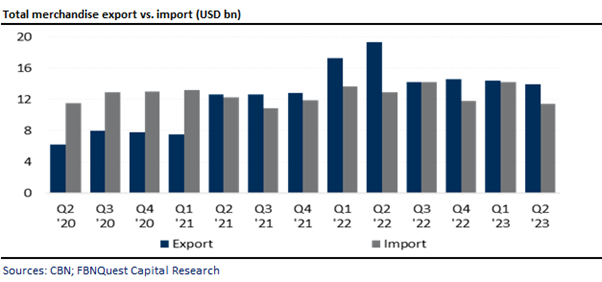
The most recent quarterly economic report published by the Central Bank of Nigeria (CBN) shows that the total value of Nigeria’s merchandise trade decreased by -12% q/q to USD25.3bn in Q2 ’23. Although the value of merchandise exports dropped by -3% q/q to USD13.9bn, the reduction in the trade value was primarily driven by a marked decline of -20% q/q in the value of imports to USD11.4bn. The external trade position resulted in a higher net surplus balance of USD2.5bn, compared with USD0.1bn in the previous quarter.
As expected, crude oil and gas exports dominated the nation’s exports trade, accounting for approximately 88% of the total export trade value. However, it declined by -3% q/q to USD12.2bn.
The m/m drop in crude oil and gas was primarily driven by an average price decrease of -4% q/q on Nigeria’s benchmark crude, the Bonny Light, because of the higher supply of crude oil on the global market.
Another factor responsible for the lower export trade value during the quarter was a reduction in the average crude oil output to c.1.14 million barrels per day (mbpd) from 1.28mbpd the previous quarter.
Revenue from non-oil exports, which accounted for around 12% of Nigeria’s total export trade, decreased by -3% q/q to USD1.7bn.
The lower value of non-exports earnings can be attributed to reduction in the trade exports of cocoa beans, sesame seeds, cement, and urea.
- Turning to merchandise imports, the q/q decline in import value was mainly driven by lower importation of petroleum products, particularly petrol.
- Specifically, non-oil products imports, which constitute around 71% of the total imports value, increased by 8% q/q to USD8.1bn in Q2 ’23. Conversely, the value of petroleum products declined sharply to USD3.3bn from USD6.8bn the previous quarter.
- A breakdown of imports by sector shows that the industrial sector had the highest share (53%) of imports, mostly due to the CBN’s efforts in facilitating the availability of foreign exchange to the sector.
- The manufacturing, and food product sectors came next on the list, accounting for 17% and 11% of the total import value, respectively.