




December 8, 2023/CSL Research
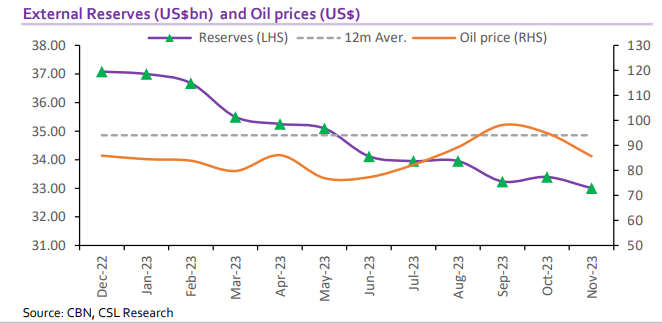
Based on figures obtained from the Central Bank of Nigeria (CBN) on movement of external reserves, the country’s external reserves have declined by US$1.65bn since the FX unification in June. The figures show that external reserves fell from US$34.12bn as of 30 June 2023 to US$32.88bn as of 4 December 2023, a 5% drop.
Though other sources like foreign remittances, foreign currency loans, and yields from foreign assets contribute to the nation’s external reserves, the major source of inflow is crude oil sales receipt. Therefore, gains in crude oil prices and an increase in crude oil production levels imply an increase in the nation’s foreign exchange reserves.
Oil prices trended up last year, given the impact of the Russia-Ukraine war on the global energy market but the country failed to benefit from the high oil prices due to the drop in production numbers attributed to crude oil theft and the decrepit oil infrastructure.
Again, failure to eliminate subsidies earlier implied subsidy payments grew with rising crude oil prices as landing cost of refined petroleum also increases with higher crude prices. The Tinubu administration announced the unification of the rates at the various FX windows and the commencement of a floating rate FX regime in June as one of the critical policies to be implemented to boost FX liquidity and the black-market rate was used as reference closing the gap between the official rates and the black-market rates.
We had expected improved FX liquidity and reduced pressure on the nation’s reserves following the FX unification as private sector inflow of FX into the economy increases and the CBN ceases to aggressively intervene in the FX market.
However, FX pressures remain and the CBN has continued to intervene in the market as another wide margin between the official rate and the parallel market rate has since been created. We have always argued that a focus on rate convergence without structural reforms to increase the supply of FX will be a case of treating the symptoms while ignoring the underlying cause of the problem which is an acute shortage of supply amidst a growing demand for FX.
Click here to read full PDF copy of report

