



December 21, 2023/CSL Research
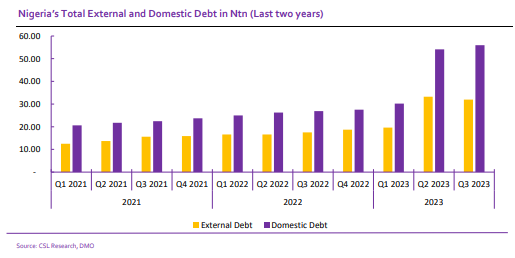
The Debt Management Office (DMO) recently released Nigeria’s total public debt portfolio for September 2023. The nation’s total public debt grew to N87.91tn (US$114.35bn) compared with N87.38 trillion (US$113.42 billion) for the period ending 30 June 2023 but was 99.52% y/y higher than the total public debt of N44.06tn recorded in the same period of the prior year. The y/y growth was mainly due to the devaluation of the Naira as the conversion rate used in converting external debt to Naira is now pegged at N768.76/US$ compared with N432.37/US$ previously and the inclusion of the securitized ways and means loans into the debt stock. External debt of N31.98tn made up 36.38% of the country’s total public debt while domestic debt (N55.93tn) made up 63.62%.
Nigeria’s total public debt has been on the rise in recent years. The government’s fiscal deficit for 2023 is the highest on record, as revenue mobilization remains largely constrained and spending continues to jump. The country’s debt service to revenue ratio also continues to rise.
Nigeria’s tax base remains narrow, and the country’s dependence on oil revenue, makes it vulnerable to fluctuations in global oil prices. The Naira’s depreciation against major currencies like the US Dollar also makes existing foreign-denominated debt more expensive to service in Naira terms, contributing to the overall debt burden.
We believe that, while the country’s revenue generating capacity remains constrained, the currency depreciation will benefit oil revenues, and as a result, we believe that the increase in income could help control the country’s rising debt stock in the short run. Furthermore, we believe that the elimination of fuel subsidies, which took up more than 75% of gross oil revenue in 2022, will free up revenue, making us believe the country may not exceed the estimated budget deficit of N9.18tn in its 2024 budget of hope. However, the continuous depreciation of the Naira and downgrading of Nigeria’s Eurobonds may limit the government’s external borrowings.
Click here to read full PDF copy of report

