December 28, 2023/FBNQuest Research
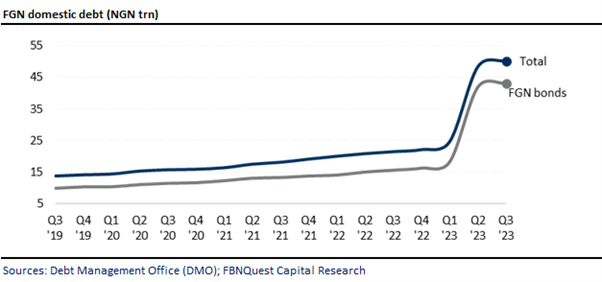
Our chart today shows that the FGN’s total domestic debt stock increased by 4% q/q to NGN50.2trn as at the end of Q3 ’23, according to the most recent data from the Debt Management Office (DMO). The FGN’s share of domestic debt represents 90% of the nation’s total domestic debt stock of NGN55.9trn, with the balance comprising of the domestic debt of the state governments and the federal capital territory (FCT). Our chart shows that the domestic debt more than doubled y/y in Q2 ‘23, primarily due to the inclusion of NGN22.7trn ways and means advances obtained by the federal government from the CBN into the overall public debt stock.
The FGN’s total domestic debt stock is equivalent to roughly 22% of 2023f GDP. However, if we include the domestic debt of the states and the FCT, the figure rises to 24.6% of ‘23f GDP.
The breakdown of the domestic debt shows that the proportion of FGN bonds, usually the largest component of the overall debt mix, decreased slightly to 86% from 87% in Q2 ’23.
A key reason for the increase in FGN bonds, and consequently domestic debt stock, is the DMO issuing over NGN5.3trn in bonds this year (NGN5.9trn with non-competitive allotments considered).
Given the tight external financial conditions, the DMO has had to depend heavily on domestic debt sources to help plug the FGN’s budget deficits.
Returning to the breakdown of the FGN’s domestic debt split, Nigerian Treasury bills (NTBs) accounted for the second largest share at NGN4.7trn or 9.4% of the total.
The FGN’s domestic debt stock balance also includes smaller amounts in Treasury bonds, savings bonds, sukuks, and promissory notes, totalling approximately NGN2.3trn, representing 4.6% of the total.
The total domestic debt stock accounts for around 64% of total public debt, with the FGN’s share accounting for c.57%.
Given the escalating debt service costs, reflected in a debt-service-to-revenue ratio of 67% as of 9M ’23, the rising public debt remains a source of concern regarding its sustainability.
The FGN’s 2024 budget proposals show planned borrowings of NGN7.8trn, of which NGN6.1trn is to be sourced from domestic borrowings.