




January 9, 2024/CSL Research
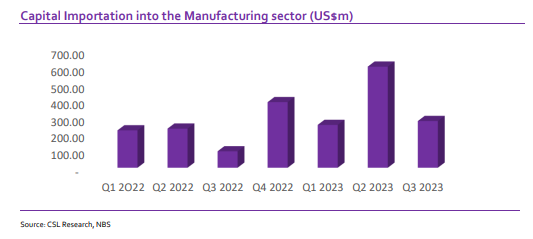
The National Bureau of Statistics (NBS) capital importation data showed the manufacturing sector attracted investments worth US$279.5m in Q3 2023 compared to US$605.04m in Q2 2023, a significant decline of 54% q/q. The NBS data also revealed that the manufacturing sector accounted for 42.70% of the total capital inflow into the economy in Q3.
We note that Nigeria’s total capital importation into Nigeria in Q3 2023 was US$654.65 million, lower than US$1.16 billion recorded in Q3 2022. On a q/q basis, capital importation declined by 36.45% from US$1.03 billion in Q2 2023.
Investments in the sector have been on a decline due to the country’s increasingly harsh business environment, characterised by high energy costs, lack of access to funding, multiple taxation, inflation, and FX challenges. This was further exacerbated by the latest reforms of the new administration in 2023, such as the fuel subsidy removal and the unification of the exchange rates at the various windows.
Players in the sector saw significant increases in net foreign exchange loss because of the Naira devaluation in June 2023. Manufacturers have tried to pass on the associated increase in cost of production to consumers, but this affected volumes, particularly for non-essentials due to the constrained purchasing power of consumers.
The poor business conditions have led to the exit of some multinationals such as GlaxoSmithKline (which exited Nigeria in August) and Unilever, which winded down operations of its home and skin care categories in April. In the fourth quarter of 2023, more multinational manufacturers such as Sanofi-Aventis and Procter & Gamble also wound down operations in Nigeria.
MAN has recently stated that if the cost of doing business in the country is not reduced, more international manufacturing companies will exit the country.
We maintain our view, that to boost investments in the sector, the government needs to find ways to ameliorate the problems faced by manufacturers such as prioritizing forex intervention for companies in the sector, improving infrastructure such as power, and putting an end to the multiple taxes levied on manufacturers.
Click here to read full PDF copy of report

