



June 28, 2024/CSL Research
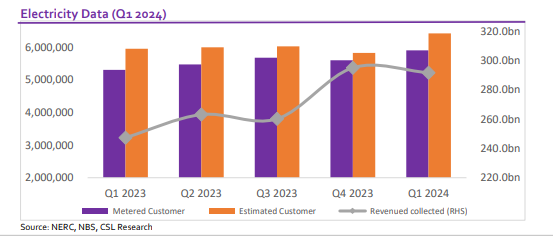
Data from the Nigerian Electricity Regulatory Commission (NERC) revealed a 17.9% y/y increase in revenue collected by the Electricity distribution companies (DisCos) to N291.6bn in Q1 2024 from N247.3bn in Q1 2023. This was however a slight decline of 1.1% q/q from N294.9bn in Q4 2023. Total customer numbers grew 9.5% in Q1 2024 to 12.33m from 11.27m
in Q1 2023. Of the 12.33m customers, only 5.91m (47.9%) were metered, while 6.42m (52.1%) remained under estimated billing. Ineffective metering remains a major drawback to the success of power sector reforms in Nigeria. While some consumers avoid paying for power consumed through meter bypass, some other consumers are made to pay for what they have not consumed through estimated billing by DisCos.
DisCos have struggled with metering their customers. As far as inadequate metering is concerned, DisCos, over time, have used this situation to their advantage via estimated billings. The Meter Asset Provider (MAP) Regulation, which became effective on 3 April 2018, introduced meter asset providers as a new set of service providers in the Nigerian Electricity Supply Industry. However, the request for payment before the provision and installation of Meters was a disincentive for the mass adoption of prepaid meters despite the known benefits, giving rise to the CBN sponsored mass metering plan.
The Federal Government launched the National Mass Metering Programme (NMMP) in 2020 and the CBN, in October of the same year, issued the Framework for its financing. The initiative is geared towards mass metering of Nigerians by providing loan facilities to (i) the DisCos (for the procurement of meters for its customers), and (ii) the local meter Manufacturers (for the manufacturing and assembling of meters). The purchase price of the meter is to be programmed into the prepaid meter allowing consumers to collect the meter for free whilst the cost is spread and billed into the tariffs payable by such consumers. At the start of the program, the metering gap was estimated at about 9.8 million meters and according to current data, 6.4m customers remain unmetered.
Click here to read full PDF copy of report

