
July 5, 2024/FBNQuest Research
In a May 2024 report, the International Monetary Fund (IMF) suggested removing electricity subsidies, stating that adjusting tariffs could cut subsidy costs by approximately 0.1% of GDP while continuing to help people experiencing poverty, especially in rural areas. Subsequently, following approval from the Nigerian Electricity Regulatory Commission (NERC), several distribution companies, including the Ibadan, Eko, and Kaduna Electricity Distribution Companies, announced another tariff increase for band A customers beginning July 1, 2024.
- Band A (20+ hours of power supply), which accounts for over 1.9 million customers, will see a 1.3% tariff increase to N209.5/kWh, the second hike since April 2024.
- As at Q1 2024. the National Bureau of Statistics (NBS) latest electricity report showed that the total number of customers rose by +1.8% q/q and 8.3% Y-o-Y to 12.3 million.
- Similarly, the metered customers rose by 5.4% q/q and 8.9% Y-o-Y to 5.9 million.
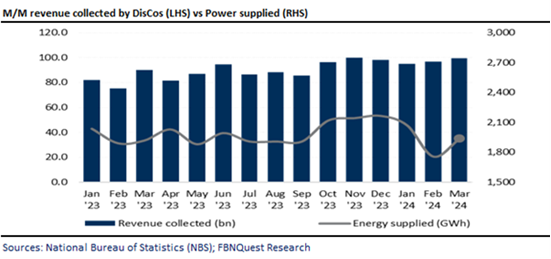
- Revenue collected by the Distribution Companies (DISCOs) declined by 1.1% q/q to NGN291.6bn but was higher by 17.9% on a Y-o-Y basis.
- The Ikeja Disco generated the highest revenue at N57.9bn in Q1 2024, down 3.1% q/q, but up 16.3% on a Y-o-Y basis. Conversely, revenue for the Yola Disco decreased by 18.7% q/q to N5.5bn (+10.5% Y-o-Y).
- In Q1’24, electricity supply totaled 5,769 GWh, marking a 10.3% q/q and 1.4% Y-o-Y decrease.
- Consistent with revenue trends, Ikeja Disco led in terms of power supplied, recording a 15.1% q/q and 11.3% Y-o-Y decrease to 908.3 GWh in Q1’24.
- Likewise, Yola Disco reported the lowest supply, declining 27.5% q/q, but was +30.2% higher on a Y-o-Y basis to 183.4 GWh.
- Notably, inflationary trends and exchange rate volatility contributed to a +54.9% M-o-M rise in electricity subsidies to N158.5bn in June.
- Although the recent tariff hike aims to improve the electricity sector’s liquidity challenges, it will contribute to the inflationary pressures affecting end-users.