

July 10, 2024/FBNQuest Research
The World Bank’s June global economic prospects report emphasises the need for governments to strengthen the resilience of their agriculture sector and ensure food security. The report advises against export restrictions, strengthening agricultural food systems, and providing targeted social protection and cash transfers to vulnerable households to address food insecurity. Additionally, the report urges governments to invest in research and development to boost agricultural productivity.
- According to the Food and Agriculture Organization’s (FAO) monthly report, global prices for major cereals decreased in June.
- Cereal prices decreased by 3.0% m/m and 9.0% Y-o-Y due to increased production and the seasonal influence of ongoing harvests in major exporting nations.
- Global wheat prices significantly declined in June, driven by robust harvests in major producing regions and Turkiye’s temporary import ban designed to protect its farmers from low produce prices.
- Similarly, global maize prices dropped, primarily due to generous export quotations from Argentina and Brazil, also driven by expectations of abundant harvests.
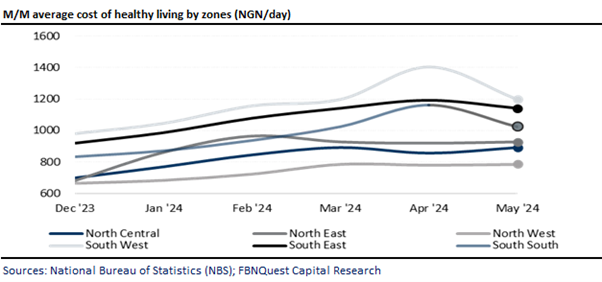
- Despite the recent improvement in global food prices, food prices in Nigeria remain elevated.
- Furthermore, government-initiated cash transfers and other food support programs are ineffective in addressing inflation.
- For context, the country’s headline inflation rose by 26bps to 33.95% Y-o-Y in May, up from 33.69% the previous month. Food and core inflation were elevated at 40.66% and 27.04%, respectively.
- Key inflation drivers remain insecurity in food-producing states, crop infestations leading to poor harvests, and exchange rate depreciation.
- Amid these challenges, the Nigerian government has announced plans to suspend taxes on food imports such as wheat and maize for 150 days (approximately five months) and propose revised retail prices.
- While commendable, the recent hike in premium motor spirits prices adds another layer of inflationary pressure, potentially muting the impact of the tax suspension on food imports.