





July 18, 2024/CSL Research
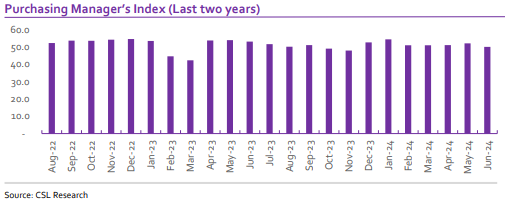
The Nigerian private sector exhibited a broad slowdown in June 2024, as evidenced by the Stanbic IBTC headline Purchasing Managers’ Index (PMI) dipping to a seven-month low of 50.1. This deceleration stemmed primarily from a weakening in domestic demand and significant price pressures.
Weaker demand led to slower growth in new orders and overall output, as customers became more cautious in the face of rising prices. The Nigerian Manufacturing Purchasing Managers Index (PMI) gauges the activity level of purchasing managers in the manufacturing sector. A reading above 50 signals expansion, while below 50 indicates contraction.
Weakened domestic demand, coupled with escalating price pressures, led to a notable slowdown in new order growth, the weakest in seven months. This trend suggests that businesses and consumers alike are exercising caution in response to rising costs.
Additionally, inflationary pressures intensified in June, with purchase prices, staff costs, and selling prices all accelerating at a faster pace than in May. This surge in costs was largely attributed to currency depreciation and elevated raw material prices.
Subdued demand conditions allowed companies to reduce their backlogs of work with some firms indicating they had cleared all outstanding business. As new order growth slowed and backlogs decreased, most companies kept their staffing levels unchanged in June.
Employment saw a slight increase for the second consecutive month. Despite these challenges, purchasing activity remained robust, as businesses likely stockpiled goods in anticipation of further price increases.
The trajectory of the private sector in the coming months will likely hinge on the effectiveness of efforts to manage inflationary pressures, the evolution of domestic and external demand and the implementation of supportive government policies.
While business confidence dropped to a record low in June, there is optimism among firms with plans for business expansion, securing new finance, and exploring export opportunities. These proactive strategies suggest that companies are looking forward to growth and are prepared to navigate the current economic challenges successfully.
Click here to read full PDF copy of report

