




July 25, 2024/CSL Research
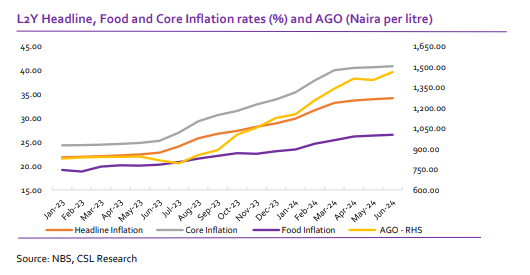
The National Bureau of Statistics (NBS) June 2024 report showed a significant increase in the average retail price of diesel across Nigeria in June 2024. The average price reached N1,462.98/litre, marking a 79.32% y/y increase and a 4.20% m/m increase compared to May 2024.
This upward trend is attributed to several factors, including the weakening Naira, disruption in distribution channels, and rising global crude oil prices. Regional variations in diesel prices were also observed, with the North-East region experiencing the highest average price at N1,659.07/litre, while the South-West region recorded the lowest average price at N1,280.54/litre.
The full deregulation of diesel prices has exposed the market to the full impact of currency fluctuations and global oil price volatility, leading to significant price increases. However, due to the reintroduction of subsidies on petrol, the price of Premium Motor Spirit (PMS), commonly known as petrol, has remained relatively stable.
Diesel fuels a wide range of essential activities, including manufacturing, transportation, agriculture, and power generation. As diesel prices climb, the cost of production and distribution increases, ultimately driving up the prices of consumer goods and services.
Consequently, core inflation has risen, eroding individuals’ purchasing power and increasing the cost of doing business. The National Bureau of Statistics (NBS) reported that core inflation rose to 27.40% y/y in June, highlighting the pervasive impact of rising diesel costs.
The agricultural sector, a cornerstone of the Nigerian economy, has been particularly vulnerable to the recent surge in diesel prices. Farmers rely heavily on diesel-powered machinery for planting, harvesting, and processing crops. Additionally, the increased transportation costs for moving produce from farms to markets further exacerbate the problem.
These factors have converged to drive up food prices, causing the food inflation rate to soar to record breaking levels reaching 40.87% in June 2024. This rapid increase in diesel prices threatens Nigeria’s already precarious food security situation.
Click here to read full PDF copy of report

