

October 22, 2024/FBNQuest Research
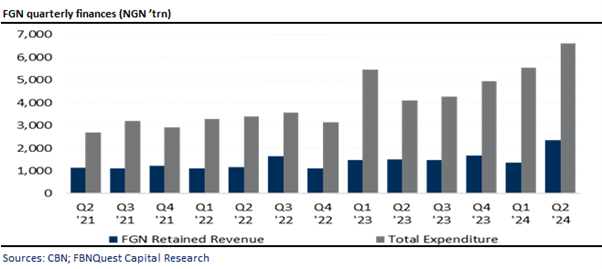
A closer look at the Central Bank of Nigeria’s (CBN) Quarterly Statistical Bulletin (QSB) shows that the FGN’s fiscal deficit in Q2 2024 widened to about N4.3trn compared with deficits of N4.2trn and N2.6trn registered in Q1 2024 and the year-earlier period. Cumulatively, the FGN’s retained revenue and expenditure amounted to about N3.7trn and N12.2trn over the 6M 2024 period, implying a fiscal deficit of roughly N8.4trn. When annualised, the fiscal deficit over the 6M 2024 period implies a deficit-to-GDP ratio of around 7.3% of 2023 GDP.
- The FGN’s retained revenue significantly improved to N2.4trn from N1.4trn in Q1 2024. However, the robust growth was insufficient to offset the rise in aggregate expenditure, which increased by 19% q/q to N6.6trn.
- The federation account has largely benefited from exchange rate gains due to the naira depreciation and enhanced efficiency in tax collections.
- On the expenditure front, the quarter-on-quarter (QoQ) rise in FGN total expenditure was recurrent expenditure, which grew by 31% QoQ to N5.8trn.
- Debt service costs, which increased by 66% q/q to N3.8trn, were the primary driver of the higher recurrent expenditure, accounting for about 65% of the total.
- However, due to the improved revenue intake, the debt service to revenue ratio declined marginally to 160% in Q2 2024, down from 165% in the previous quarter.
- Despite the slight reduction in the debt payment to revenue ratio, the rising cost of debt service highlights the continuing strain on the government’s fiscal purse.
- In contrast, capital expenditure, which accounted for 13% of total expenditure, decreased by -27% QoQ to N856.5bn.
- Looking ahead, we forecast a 2024 fiscal deficit of 4.7% of GDP, significantly higher than the 3.9% proposed in the 2024 budget.
- Our projection results from the expected increase in the FGN’s expenditure profile resulting from the 2024 supplementary budget and rising debt service costs because of elevated local borrowing costs.