




November 13, 2024/Meristem Research
Inflation in advanced economies continued its downward trend in September 2024, with some countries’ rates falling below target thresholds. Notably, inflation in the Eurozone and UK fell to 1.80% year-on-year (YoY) and 1.70% YoY, respectively, driven by stabilised energy prices and reduced service inflation, especially in the UK. Meanwhile, U.S. inflation declined to 2.40% YoY (lowest since March 2021) due to lower energy prices despite persistent inflation in food and service.
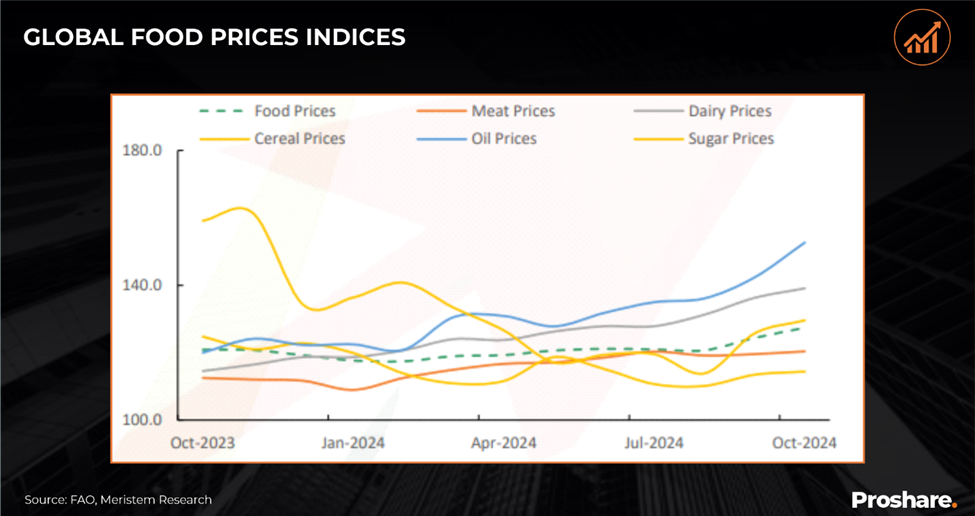
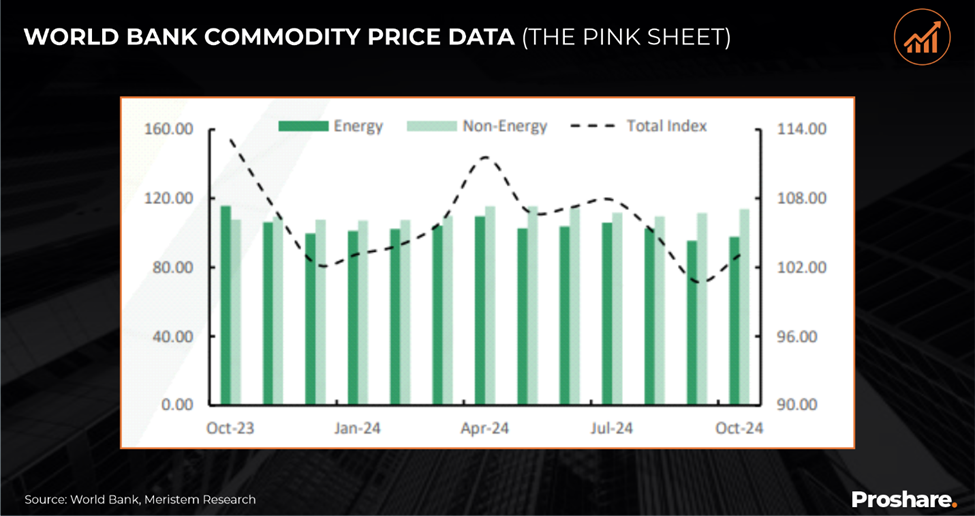
The rise in food prices is reflected in the Food and Agriculture Organization (FAO) Food Price Index (FFPI), which reached an 18-month high of 127.35 points in October 2024, a 1.98% increase from 124.39 points in September 2024. This increase was primarily driven by gains in the vegetable oil index (+7.27%), sugar index (+2.62%), dairy index (+1.87%), and cereals index (+0.79%). Likewise, the World Bank Commodity Index rose by 2.31%, supported by increases in the Energy Index (+2.44%) and the Non-energy Index (+2.08%).
Analysts at Meristem expect the disinflation trend to continue, driven by easing energy and service prices. However, seasonal demand may challenge this outlook, potentially leading to sustained increases in food prices. In the U.S., persistent services and food inflation could hinder efforts to reduce inflationary pressures, while proposed expansionary fiscal policies in the UK may present an upward risk to inflation in that region (see charts below)
Inflation Reversal: Domestic Pressures Push Headline Inflation Up
Headline inflation reversed its decline in September 2024, climbing to 32.70% from 32.15% in August after two months of disinflation. As of September 2024, food inflation rose to 37.77%, while core inflation stood at 27.43%.
In October, inflationary pressures remained strong, driven by persistent legacy issues in the country’s food sector and the lingering effects of the September flash floods. This led to decreased crop yields, undermining expectations of a bumper harvest and pushing food prices higher during the month. Additionally, the rise in transportation costs (fueled by an approximate 15% increase in PMS prices during the month) further impacted food prices. Moreover, the continued depreciation of the Naira, which raised the costs of import-dependent goods such as clothes, footwears, furnishings & household equipment, among others, added to the overall inflationary pressures. For context, the Naira weakened further on the NAFEM window, averaging N1635.11/$ in October 2024, compared to N1589.86 in September.
Thus, we expect food inflation to maintain its upward trend in October, driven by the abovementioned factors. Furthermore, we anticipate a rise in core inflation for October, driven by rising fuel prices and ongoing naira depreciation.
Overall, due to these combined factors, we project a sustained increase in the country’s inflation in October 2024 (see charts 3 below)
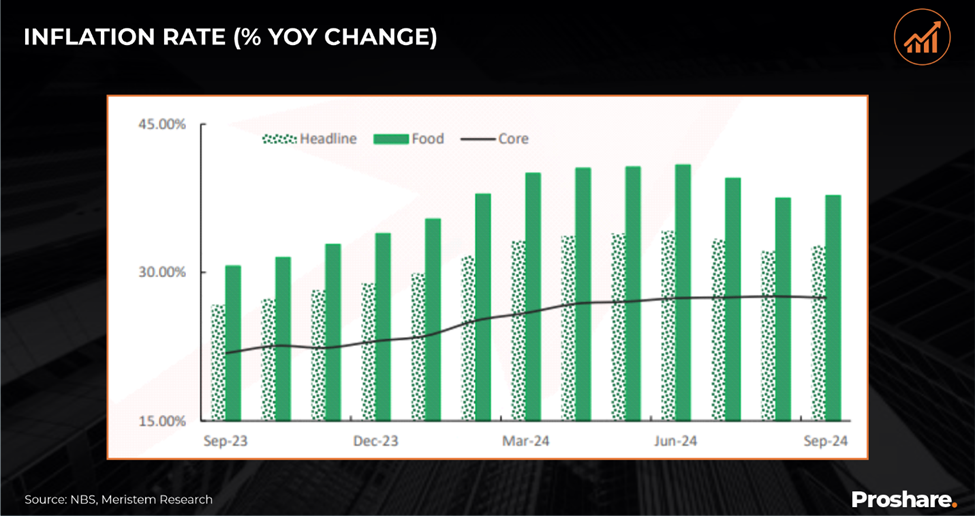
Thus, Analysts at Meristem Research expects:
Headline Inflation at – 33.48%, compared to 32.70% in September 2024, representing a 78bps increase.
Food inflation at – 38.50%, compared to 37.77% in September 2024, representing a 73bps decrease.
Core inflation at – 28.64%, compared to 27.43% in September 2024, representing a 121bps increase.
Core Inflation – includes All items less farm produce and energy

