

November 14, 2024/FBNQuest Research
The Debt Management Office’s (DMO) quarterly release on public debt shows that Nigeria’s total external debt payments increased slightly by +2% quarter-on-quarter (QoQ) but fell by -1% year-on-year (YoY) to US$42.9bn in Q2 2024. However, in naira terms, the rise in the nation’s stock of external debt was more pronounced, rising by +13% QoQ and +90% YoY, primarily reflecting the depreciation of the naira. Regarding composition, the Federal Government of Nigeria (FGN) is responsible for approximately 89% of the country’s total external debt. The balance of 11% comprises debt owed by state governments to multilateral and bilateral lenders, guaranteed by the FGN.
- In standardised terms, the total external debt stock equals 27.4% of 2023 GDP. This compares with 14.5% and 24.4% registered in Q2 ’23 and Q1 ’24, respectively.
- The share of external debt obligations on the nation’s total debt stock has risen from 38% in Q2 ’23 to about 47% in Q2 ’24, underscoring the adverse impact of the naira devaluation on the country’s dollar-denominated debt.
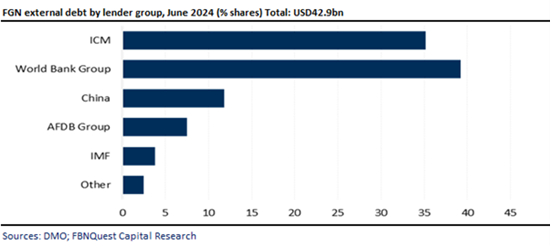
- The marginal QoQ rise in external debt borrowing is primarily due to a +4% QoQ (US$799m) increase in debt owed to multilateral lenders to about US$21.6bn.
- This mainly was due to the rise in a US$1.2bn (+8% q/q) loan from the World Bank. A smaller increase of US$28m in debt owed to China also contributed to the overall increase.
- These increases were partially offset by a reduction of US$419m q/q, or -21% q/q, to US$1.6bn in debt owed to the IMF and a lesser reduction of -US$13m q/q in smaller loans from other bilateral lenders.
- As a result, the proportion of multilateral and bilateral debt to total external debt stood at 50.4% and 13.7%, respectively, compared with 49.5% and 14.50% in Q1 ’24.
- Notably, debt owed to commercial lenders remained unchanged at US$15.1bn q/q, reflecting tight financial market conditions globally.
- Looking ahead, we anticipate a further rise in the nation’s external debt burden, evidenced by the series of loans worth US$3.8bn approved by the World Bank and the negative impact of ongoing naira volatility on external debt stock.