



January 16, 2025
By InvestAdvocate
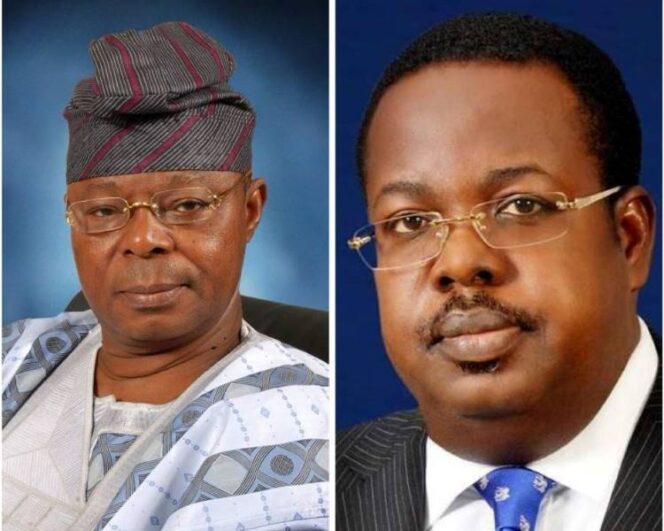
Lagos (INVESTADVOCATE)-The Economic and Financial Crimes Commission (EFCC) has leveled a damning 13-count charge against Chief Oba Otudeko, Chairman of Honeywell Group, and Olabisi Onasanya, former Managing Director of First Bank, over an alleged fraudulent scheme involving ₦12.3 billion.
The charges, filed at the Federal High Court in Lagos, also implicate Soji Akintayo, a former director of Honeywell Flour Mills, and Anchorage Leisure Ltd., a company linked to Otudeko. The arraignment is scheduled for Monday, January 20, 2025, before Justice Chukwuejekwu Aneke.
Court filings by EFCC prosecutor, Bilkisu Buhari-Bala, which were obtained by InvestAdvocate reveal that the alleged financial improprieties occurred between 2013 and 2014.
The defendants are accused of securing funds through a series of fraudulent claims, including amounts of ₦5.2 billion, ₦6.2 billion, ₦6.15 billion, ₦1.5 billion, and ₦500 million. The funds were purportedly obtained as credit facilities for V-Tech Dynamics Links Limited and Stallion Nigeria Limited under false pretenses.
The EFCC asserts that the transactions contravened Section 8(a) of the Advance Fee Fraud and Other Fraud Related Offences Act, 2006, which is punishable under Section 1(3) of the same statute.
The first count alleges that the defendants conspired to secure ₦12.3 billion from First Bank, misrepresenting the funds as legitimate credit facilities.
In a separate charge, the prosecution claims that on November 26, 2013, the accused fraudulently obtained ₦5.2 billion from First Bank by falsely presenting the amount as a loan application by V-Tech Dynamics Links Limited.
The case is expected to attract considerable attention, with key witnesses from First Bank, the Central Bank of Nigeria, Stallion Nigeria Limited, and V-Tech Dynamics Links Limited set to testify. The EFCC has pledged to substantiate its claims with compelling evidence.
This development underscores the anti-graft agency’s intensified efforts to address financial malfeasance and ensure accountability among Nigeria’s corporate and financial elite. The trial’s outcome could reverberate across the nation’s financial sector and serve as a benchmark in the fight against economic crimes.
First Bank of Nigeria Limited, parent company of First Bank of Nigeria Holdings (FBNH) Plc, has been in a legal and commercial conflict with General Hydrocarbons Ltd (GHL) over credit facilities extended for the development of Oil Mining Lease (OML) assets.
The dispute, which has captured widespread public and media attention, revolves around alleged contractual breaches, loan repayment defaults, and governance concerns.
In a release on Tuesday, the lender stated that its actions were a necessary response to GHL’s non-compliance with agreed loan terms, including the diversion of crude oil proceeds intended for debt repayment.
FirstBank stated that it fulfilled its obligations under robust loan agreements with GHL but was met with resistance when it demanded enhanced transparency and governance. GHL, the bank alleges, diverted proceeds from crude oil sales and rejected proposals for an independent operator to manage financed assets.
“At the root of the present dispute is FirstBank’s demand for good governance and transparency in the transaction,” the bank explained in its statement.
“These demands, aimed at ensuring accountability and protecting stakeholder interests, were outrightly rejected by GHL.”
The conflict escalated when GHL sought a $53 million loan to continue developing its OML 120 project. FirstBank declined, citing unresolved breaches and the diversion of funds. Instead, the bank proposed measures to restore accountability, including appointing a mutually agreed-upon independent operator, a suggestion that GHL reportedly refused.
Rather than address these issues, GHL initiated arbitration proceedings and secured a Mareva injunction to freeze $225 million in assets.
FirstBank responded by filing a substantive claim in court to recover diverted funds and prevent further breaches.
FirstBank accused GHL of orchestrating a media campaign to misrepresent the dispute, describing the narratives as “sponsored” and “misleading.”
“We are constrained to issue clarifications to counter the false narratives being propagated in certain media outlets,” the statement read. “FirstBank remains committed to transparency and fairness and will not succumb to media blackmail aimed at pressuring the bank into compromising its principles.”
FirstBank emphasized that its legal actions were aimed at preserving assets and recovering funds due to breaches by GHL.
“As a secured lender, FirstBank had no choice but to approach the court for legal remedies,” the bank explained. “This was imperative given the continued breaches, non-payment of due obligations, and attempts by GHL to shield the bank from agreed security and repayment sources.”
The FirstBank crises underscore deeper issues of governance and risk management within Nigeria’s financial ecosystem.
The outcome of the ongoing legal and arbitration proceedings will likely set a precedent for similar cases in Nigeria’s financial and oil sectors as well as the pattern of lender-borrower relations in the country.

