





January 28, 2025/FBNQuest Research
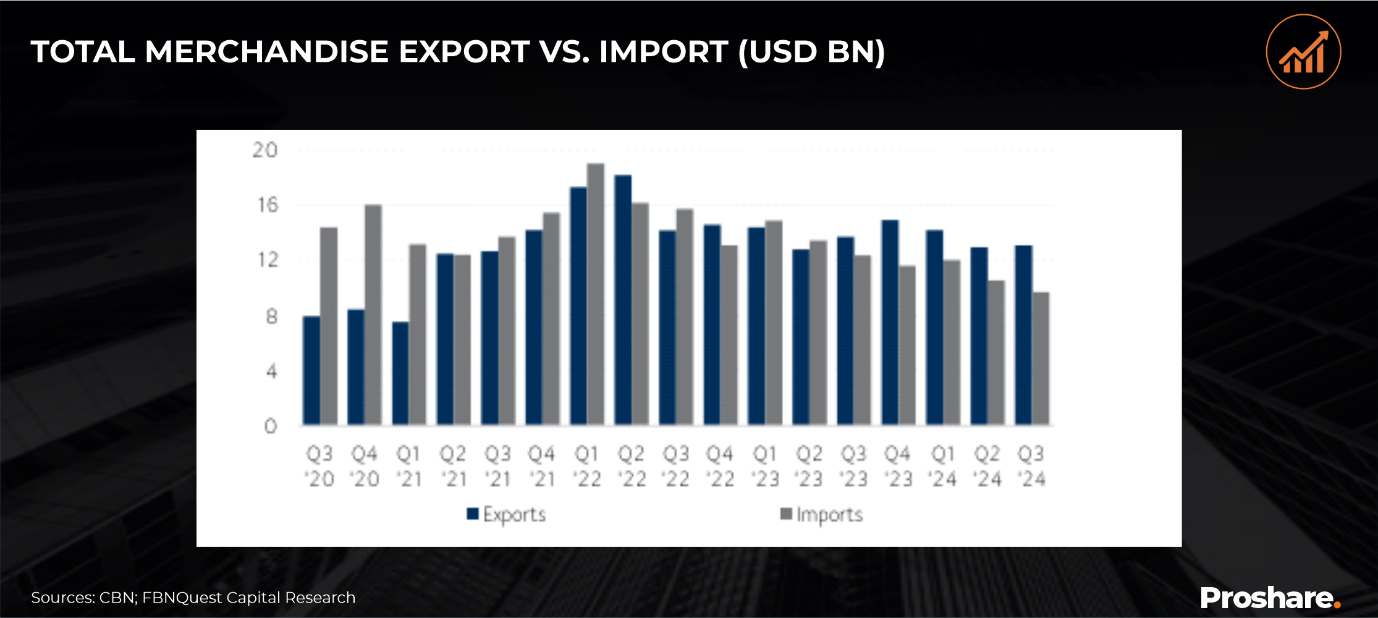
The Central Bank of Nigeria (CBN) disclosed that the total value of Nigeria’s merchandise trade decreased by -3% quarter-on-quarter (QoQ) and -13% year-on-year (YoY) to US$22.8bn in Q3 2024 according to the Quarterly Statistical Bulletin (QSB). The sequential reduction in the nation’s trade position was primarily due to a decrease in import trade value, which reduced to US$9.7bn compared with US$10.6bn reported in the previous quarter. However, the value of Nigeria’s merchandise exports saw a slight increase of 1% QoQ to US$13.1bn.
- As a result, the net trade position resulted in a higher net trade surplus of US$3.4bn compared with US$2.4bn and US$1.4bn in Q2 2024 recorded in Q2 2024 and the year-earlier period, respectively.
- With the surplus in Q3, Nigeria’s net trade balance has now posted surpluses for the fifth consecutive quarter.
- Although exports have seen modest improvement, the consistent positive trade balance was mainly driven by a significant reduction in Nigeria’s import trade balance.
- For instance, the data show that total merchandise imports over the 9M 2024 period amounted to US$72.5bn, implying a decline of -11% year over year compared with US$81.6bn over the year-earlier period 2023.
- The apparent reduction in Nigeria’s import balance can be explained by the expensive pricing of foreign exchange currency, which has discouraged demand for imported items.
- Returning to the data, the value of crude oil exports (excluding gas) in Q3 was reduced to US$8.4bn from about US$9.0bn in the previous quarter. Consequently, its share of total export value fell to 64%, down from 69% in Q2.
- On the other hand, non-oil exports increased by 6% QoQ to US$1.9bn, with its share of overall exports increasing slightly to 14.3%, up from 13.7% in the preceding quarter.
- Regarding imports, non-oil imports, which dominate the nation’s import bill, increased slightly to US$6.3bn from US$6.2bn in the prior quarter.
- Conversely, the importation of oil products fell significantly by -24% QoQ to about US$3.0bn in Q3, following the removal of fuel subsidies and ramp-up of domestic refined petroleum products.
- Looking ahead, analysts at FBNQuest anticipate a sustained trade surplus driven by increased refining capacity and subdued import demand.
Culled: Proshare

