

Culled—Proshare
September 5, 2017/Vetiva Research
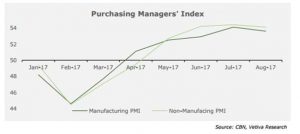
Economic activity expanded once again in August as both Manufacturing (53.6) and Non-Manufacturing (54.1) Purchasing Managers’ Indices (PMI) recorded above-50 readings for the fourth consecutive month. Even as recently released Q2’17 GDP numbers indicated that the Nigerian economy exited recession with a 0.55% y/y growth, strong PMI readings indicate a resilient economic recovery in Q3’17, suggesting a possible improvement in economic activities.
Industries continue on growth path
The manufacturing sector expanded for the fifth straight month (53.6), albeit at a slower pace compared to July (54.1). Manufacturing production (57.4) continued to expand, though at the weakest pace since Q1’17, whilst the pace of expansion in New Orders (52.3) and Employment Levels (51.5) also slowed marginally. The quickest growing segments in August were Computer & Electronic products (69.2) and Chemical & Pharmaceutical products (59.9). However, overall price levels continued to spiral, with manufacturing price indices rising for the 20th straight month.
Similarly, the non-manufacturing sector expanded at a slower pace in August. Across the sub-indices, Business Activity (56.1) and New Orders (53.5) decelerated whilst Employment Levels (54.4) and Inventories (52.3) accelerated during the month. E-commerce related activities received a notable boost in August as Information & Communication (58.7) and Finance & Insurance (58.4) led the sector growth table.
Key feature: Resilient Recovery
Consistent above-50 readings across both industries in July and August suggest that Nigeria’s economic recovery has been undisturbed so far in Q3’17. More positively, employment has steadily expanded in the past four months, pointing towards necessary easing in labour market conditions. Finally, the third straight expansion in Wholesale Trade (53.2), a particularly potent indicator of economic activity, bodes well for the near-term outlook for the Nigerian economy.
Targeting stronger growth in H2’17
Nigeria’s nascent economic recovery should be supported by continued stability in oil production, which in turn buoys Federal Government revenues, foreign exchange liquidity, and energy supply in the country. However, amidst stillstrong pricing pressures (July Inflation: 16.1% y/y), consumers remain squeezed and a shot to aggregate demand is sorely needed, perhaps by escalating efforts in rolling out the Homegrown School Feeding Programme and Conditional Cash Transfer Scheme.
Similarly, haste is required in 2017 Budget capital expenditure disbursements, amidst a ₦350 billion capex release at the start of September. We stress the importance of Federal government capital expenditure, both in supporting short-term aggregate demand, and in upgrading Nigeria’s productivity.