


Culled—Proshare
September 6, 2017/FDC
Q2 GDP Growth up at 0.55%
As widely anticipated, Nigeria’s real GDP growth in Q2’17 moved to positive territory, after five consecutive quarters of negative growth. Growth rate recorded was 1.46% higher at 0.55% compared to the revised figure of -0.91% in Q1’17. This is still lagging Nigeria’s population growth of 2.3%.
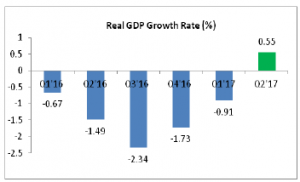
The faster pace in growth was driven by robust oil revenues due to stable oil production, reduced sabotage on pipelines, which led to improved supply of gas and increased dollar sales.
All the business and economic proxies pointed towards a faster growth rate in the review period: PMI was 55.9, average on-grid power supply was 3,524MW/hr, inflation slowed to 16.1%, CBN’s dollar sales was $5.35bn and turnover at the IEFX window was $3.74bn.
Nigeria is not alone in its path to recovery. South Africa recorded a faster pace of growth of 2.5% in Q2’17, driven by a surge (34%) in agricultural output. According to some analysts, South Africa is technically out of a recession.
Breakdown of GDP Data
The increased pace of growth was driven predominantly by growth in the oil and gas, finance and insurance and electricity and gas sectors. Other sectors such as Agric, manufacturing and construction slowed in growth but are still in the positive region.
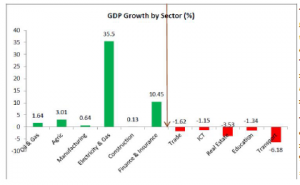
The sectors that contracted further were ICT and telecos, real estate, education and transport. Trade however recorded an improvement to -1.62% although it is still within the negative quadrant.
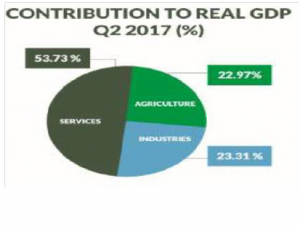
The non-oil sector’s contribution to GDP was marginally lower in Q2 at 91.11% compared to 91.21% in Q1’17.
Analysis
The GDP numbers are historical, nonetheless, the numbers will set the tone for the last 4 months in 2017. It is also a reflection of the positive impact of policies implemented. The exchange rate dependent sectors (manufacturing, trade) have improved thanks to better dollar liquidity and accessibility. However, high borrowing costs and epileptic power supply continue to act as constraints.
Agric remains a cause for concern as the sector has maintained a downward trend in spite of increased government intervention. The slowdown in construction can be attributable to seasonality. The heavy rainfall and floods during this period would have slowed activities.
The growth in the Oil & Gas sector was driven by increased production to 1.84mbpd from 1.69mbpd in Q1’17. Oil prices reached the year to date peak of $56pb in April before declining to $47pb at the end of the second quarter. The average price of Brent crude was $51.05pb compared to $54.68pb in Q1.
Policy Impact
The Monetary Policy Committee (MPC) will meet on September 25/26 and the GDP numbers will form part of the considerations at the meeting. If this positive growth is supported by favorable August inflation data, the doves in the committee will be more emboldened to push for more accommodative monetary policy stance.
Outlook for Q3’17
Economic activities in the first two months of the third quarter have improved as reflected in FBN’s PMI reading for August which is now 58.5. Manufacturers have also started raising letters of credit for Christmas inventory, for delivery in October/November. The average monthly statutory allocation shared in this period is N560bn and is projected to increase as tax receipts increase. Inflation has flattened out as food prices remain sticky downwards. The naira has strengthened on the back of increased CBN intervention while the external reserves are at a year-to-date high of $31.81bn. All these point towards a more robust growth in Q3’