

March 16, 2018/Cordros Report
Global Economy
According to data from the Labor Department, US inflation in February was slightly higher at 2.2% y/y (in line with market expectations) from 2.1% y/y in January, following faster rise in price of fuel oil, transportation services, and energy. Excluding food and energy prices, the core inflation remained at 1.80%. On a monthly basis, consumer prices rose at a slower pace of 0.2%, against 0.5% in the previous month. The gradual pace of inflation rate growth tames concerns of a faster-than-expected interest rate hike by the Fed.
China’s National Bureau of Statistics reported a stronger-than-expected industrial production data, showing 7.2% year-on-year growth for January-February. Industrial output for the period rose sharply from 6.2% in December, and surpassed analyst’s estimates of 6.1%. The data muted expectations of a slight dip, following crackdown on heavily polluting industries. The upturn in industrial production strengthens expectation for sustained output growth in the Asian giant’s economy.
Global Equities
Activities in global markets were mixed during the week, largely influenced by economic data, geopolitical concerns, and resurgent trade war concerns. Investors in US equities (DJIA: -1.82%; S&P 500: -1.41 %) turned bearish, while activities in Europe (FTSE 100: -1.04%; Euro Stoxx: +0.15%) and Asia (CSI 300: -1.28%; Nikkei 225: +0.97%) were mixed. The MSCI EM (+0.765%) closed higher, supported by gains in China, and despite a loss in Brazil (-1.67%). Meanwhile, downbeat sentiments in Nigeria (-2.85%) and Ghana (-0.42%) outweighed gains recorded in Kenya (+1.26%), causing the MSCI FM (-0.16%) index to close lower.
Nigeria
Economy
According to the National Bureau of Statistics (NBS), Nigeria’s headline consumer price index recorded its thirteenth consecutive deceleration, moderating to 14.33% y/y (compared to 15.13% in January 2018). On month-on-month basis, the headline index increased by 0.79% (vs. 0.80% the previous month). Following the higher-than-expected moderation in February inflation, we revisit our model and revise our 2018 average inflation projection lower by 68 bps to 12.47%, from 13.15%.
The Minister of Finance, on Monday, announced the approval of the amendment to the excise duty rates for alcoholic beverages and tobacco by the President. The directives seek to harmonise ECOWAS member-states’ legislations on excise duties of non-oil products. Under the new regime, beer & stout would attract a NGN0.30 per centiliter (cl) rate in 2018 and NGN0.35 per cl in 2019 and 2020 each. For tobacco, in addition to the existing 20% ad-valorem rate, each stick of cigarette will attract a NGN1 specific rate in 2018, NGN2 specific rate in 2019 and NGN2.90 specific rate in 2020. Government revenue will receive a boost from the proceeds of higher excise duty, while future investments in the tobacco sector could grapple with pressured producer profit margins.
Equities
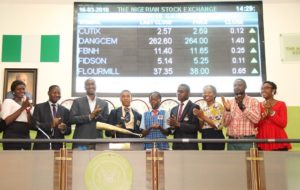
The equities market halted two consecutive weeks of gains, as the ASI plunged 2.85% w/w to 41,935.90 points, causing the Month-to-Date and Year-to-Date returns to moderate to -3.22% and 9.66% respectively. Losses recorded in four sessions of the week offset the marginal gain recorded on Tuesday. The Banking (-9.79%) index posted the largest loss among major sectoral indices, following losses in ZENITHBANK and GUARANTY shares, despite broadly positive corporate releases during the week. The Oil & Gas (-1.64%), Consumer Goods (-1.59%), and Industrial Goods (-0.24%) indices also booked losses during the week. On the flip side, the Insurance index rose marginally by 0.25% w/w.
Despite the loss recorded during the week, we reiterate our positive outlook for the equities market, as strengthening macroeconomic fundamentals suggest legroom for gains still exist.
Fixed Income and Money Market
Money Market
In line with our expectation, the overnight lending rate rose by 375 bps w/w to 12.92%, against last week’s close of 9.17%. Outflows from OMO and FX sales worth NGN582.96 billion and USD210 million, respectively, outweighed inflows from (1) coupon payments (NGN51.12 billion) from the MAR-2024 bond, (2) matured OMO bills (NGN261.86 billion), and (3) matured treasury bills (NGN191.44 billion).
Despite expected inflows of NGN226.24 billion from bond coupon payments (NGN91.14 billion), OMO (NGN151.15 billion) and treasury bills maturities (NGN107.91 billion), the overnight money market rate is likely to expand in the coming week, as we expecte the apex bank to conduct open market operations to mop up excess liquidity.
Treasury Bills
Proceedings in the NTB market were bullish, as market players reacted to the release of the NTB auction calendar for Q2-2018. The released calendar indicated a marked reduction in the amount of bills being offered (NGN481 billion) compared to the amount maturing (NGN964 billion). As a result, average yield fell by 23 bps w/w to 14.82%. High demand for the 27DTM (-105 bps), 132DTM (-62 bps), and 188DTM (-82 bps) bills caused yield contraction at the short (-32 bps), mid (-24 bps), and long (-21 bps) ends of the curve, respectively. Meanwhile, at this week’s primary market auction, NGN6.22 billion, NGN4.00 billion, and NGN85.50 billion of the 91-day, 182-day, and 364-day bills were allotted. The bills were 1.8x oversubscribed, with yields closing lower across the 91-day (11.75%; previously 11.85%), 182-day (13.00%; previously 13.50%), and 364-day (13.19%; previously 13.50%) bills.
Expected squeeze in liquidity position suggests higher yield in the meantime. At the NTB auction scheduled for next week, the CBN will offer NGN53.96 billion – NGN5.40billion of the 91-day, N26.98 billion of the 182-day, and NGN21.58 billion of the 364-day – worth of bills to the market.
Bonds
Investors in the bond market were upbeat, following the release of the bond offer circular for March by the DMO. Similar to the released NTB auction calendar, the bond circular revealed a reduced offered amount of NGN70 billion (NGN10 billion of the 5-year; NGN30 billion of the 7-year; and NGN30 billion of the 10-year) compared to the NGN140 billion earlier guided in the Q1-18 bond issuance calendar . Consequently, average yield declined by 14 bps w/w to 13.52%. Yields contracted at the short (-27 bps) and mid (- 22 bps) ends of the curve, while yields at the long segment expanded (+5 bps). Notable bonds include the JUL-2021 (-44 bps) and JAN-2026 (-27 bps).
Our theme on the bond market continues to favour lower yields, driven by (1) investors reaction to sustained moderation in inflation rate (which further dropped to 14.33% in February vs. 15.13% in January), (2) strengthening signals of monetary easing, and (3) the FGN’s new debt management strategy. At the FGN bond auction scheduled for Wednesday, 21st March 2018, the DMO plans to offer NGN70 billion – NGN10 billion of the JUL-2021 (re-opening), NGN30 billion of the JAN-2025 (new issue) and NGN30 billion of the FEB 2028 (re-opening) –in bonds to investors.
Foreign Exchange
The naira weakened against the dollar in the I&E FX window and parallel market by 0.07% and 0.28% to NGN360.57 and NGN363 respectively. Total turnover in the I&E FX window dropped by 34.38% to USD1.42 billion with bulk (57.65%) of trades remaining within the NGN360 – NGN369 band. The apex bank continued its intervention in the FX market, amidst steady accretion to the foreign reserves (+1.68% w/w to USD44.47 billion), injecting USD210 million – comprising USD100 million, USD55 million, and USD55 million disbursements to the wholesale, SMEs, and invisibles windows, respectively.
In our view, the FX market is likely to remain stable, with the naira trading within current bands, as oil revenue (supported by stable oil prices and production) continues to shore up the foreign reserves.