

30/4/2018/Fitch Ratings
The summit meeting between the leaders of North and South Korea eases tensions on the peninsula, which have been elevated in recent months, but does not eliminate risks associated with the military stand-off, says Fitch Ratings. The process of normalizing relations is likely to be lengthy and unpredictable, even if begun in earnest.
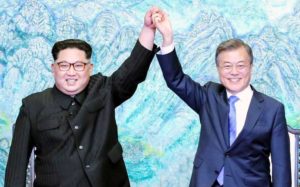
South Korean president Moon Jae-in and North Korea’s Kim Jong-un met on Friday – the first time a North Korean leader has visited South Korea since 1953 – in a summit which the South Koreans said would aim to “lay stepping stones toward denuclearization and permanent peace”. In a joint declaration, the two leaders said that South and North Korea will “actively co-operate to establish a permanent peace regime.” A liaison office will be set up and military talks held in May. A US-North Korea summit is likely to follow.
The long-term stand-off results in geopolitical risks to South Korea’s sovereign balance sheet. These relate not only to the potential for conflict, but also to the possibility of reunification costs arising over the long term. Our ‘AA-‘/Stable sovereign rating on South Korea is one notch lower than that implied by our Sovereign Rating Model, largely to take these risks into account. Reunification costs are hard to estimate due to the assumptions needed, but South Korea’s National Assembly Budget Office has put them at an average of 3.9% of GDP annually over 45 years.
Another risk from persistent and sometimes increased tensions is to South Korea’s economic performance, via hits to business or consumer confidence. However, these have not materialised so far in 2017-2018. The economy expanded by an above-trend 3.1% last year, bolstered by supportive economic policies and financial conditions, and by the pick-up in global trade. The Bank of Korea’s advanced estimate of 1Q18 real GDP growth, released last week, showed economic growth up by 1.1% qoq, and we forecast 2.9% growth in 2018 and 2.7% next year.
The constructive outcome of the Moon-Kim summit, which was unimaginable just weeks ago, should ease the heightened tensions between North and South Korea caused by last year’s escalation of the North’s nuclear weapons programme and the resulting confrontational rhetoric between the North and the US. We believe that outright conflict is unlikely – given the huge costs to both sides – while entering a period of detente would lower the risk that it could be triggered by an unexpected event or miscalculation.
Nevertheless, it is unclear whether the summit signals the start of a permanent, structural easing of geopolitical tensions on the Korean peninsula, which have tended to rise and fall in cycles. In a speech last year, President Moon said that relations needed to “return to that spirit” seen in earlier declarations in 2000 and 2007. Friday’s declaration left further details to be negotiated on measures to reduce military tensions and achieve greater economic co-operation, and the North has sometimes failed to abide by previous commitments. The outcome of diplomatic activity in the coming months is hard to predict, and tensions could re-escalate quickly if the US feels that summit diplomacy is not achieving its aim of denuclearization.