


January 17, 2024/FBNQuest Research
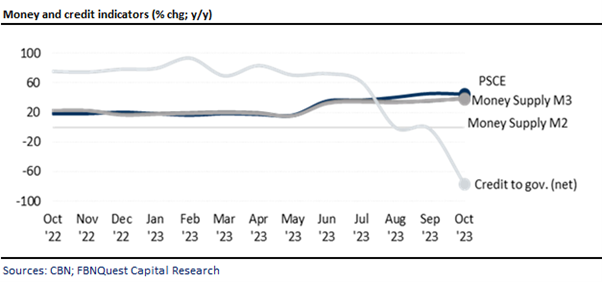
According to the most recent data from the Central Bank of Nigeria (CBN), private sector credit extension (PSCE) increased significantly by 44% y/y to NGN59.7trn as at Nov ’23. PSCE also expanded by 43% over the eleven-month period to Nov ’23. The data covers lending by the entire banking system and not only the deposit money banks (DMBs), which accounts for 69% of the total figure. Specifically, the data reflects lending by the CBN and state-owned development banks, such as the Bank of Industry, and smaller credit extension by other banks, including micro-finance banks and non-interest banks.
Credit extension to the private sector and other monetary aggregates have continued to expand despite the CBN’s implementation of various restrictive measures, including the return of Open Market Operation (OMO) auctions, Cash Reserve Requirement (CRR) debits, removal of the NGN2.0bn cap on Standing Deposit Facility for DMBs, and adjustment of the asymmetric corridor of the MPR to (+100/-300bps) from (+100/-700bps previously).
Regarding monetary aggregates, broad money supply (M3), and M2 money supply grew rapidly by 39% y/y and 38% y/y respectively.
As shown by our chart, credit extension to the government declined markedly by -77% y/y and -45% m/m to NGN5.2trn.
The sharp deceleration in credit extension to the government is unsurprising, considering the new CBN Governor’s plan to stop the financing of the government’s fiscal deficits through the Ways and Means advances and instead return to its core mandate of ensuring monetary and price level stability.
We view this as a positive development because the rise in productivity credit extension to the government has been one of the drivers of inflationary pressures in the country.
With the headline reading for December ’23 surging by 72bps to 28.92% y/y and the continuous expansion of money supply, we believe that the Monetary Policy Committee will continue to raise interest rates to sustain its efforts in combating inflationary pressures.
Although the CBN is yet to release the MPC meeting calendar for the year, we anticipate that the committee will raise the MPR by around 25-50bps at its next meeting.