





January 19, 2024/CSL Research
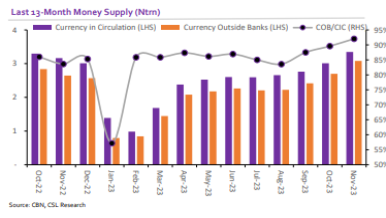
Money Supply statistics from the Central Bank of Nigeria (CBN) as of November 2023 revealed that currency in circulation (CIC) surged by 21.24% in November to N3.35trn (highest in 2023) from N2.76trn as of September 2023. In the same vein, currency outside banks (COB) rose by 27.53% to N3.08trn in November 2023 from N2.42trn.
This in essence means, 92.04% of the currency in circulation (CIC) was outside the banking system as of November 2023, marking a notable rise from the 57.14% recorded in January 2023 following a few months of the CBN naira redesign policy. The currency outside the banks had averaged c.84.42% of currency in circulation since the year 1960 till December 2022.
From reported numbers, we can conclude that the Naira redesign policy would have been moderately successful in mopping up currency outside the banks if it wasn’t reversed, as there was a considerable reduction currency outside bank in the first 4month of the policy implementation.
Between January and November 2023, currency in circulation (CIC) has risen by 141.47% (N1.96trn) and this can be attributed to the reinjection of older Naira notes into the system, which had been previously withdrawn from circulation by the CBN. In the same period, currency outside banks (COB) has surged by 288.96% (N2.29trn) on the back of rising non-bank held cash, amidst growing public concern over the sufficiency of currency in the banking system.
The persistent challenge of a substantial portion of currency in circulation outside the banking system has remained since independence, despite past currency redesigns and printing. The former Central Bank Governor’s efforts to reduce the currency outside the banking system faced considerable criticism, given the circumstances.
Nevertheless, we emphasize the importance of reducing the substantial cash held outside the banking system for the purpose of enhancing monetary policy efficacy, fostering and financial inclusion, among other objectives. Reducing cash outside the banking system also aids in combating illicit activities like terrorism and mitigating money laundering when implemented in collaboration with appropriate agencies such as the EFCC and banks.
Click here to read full PDF copy of report

