

January 24, 2024/CSL Research
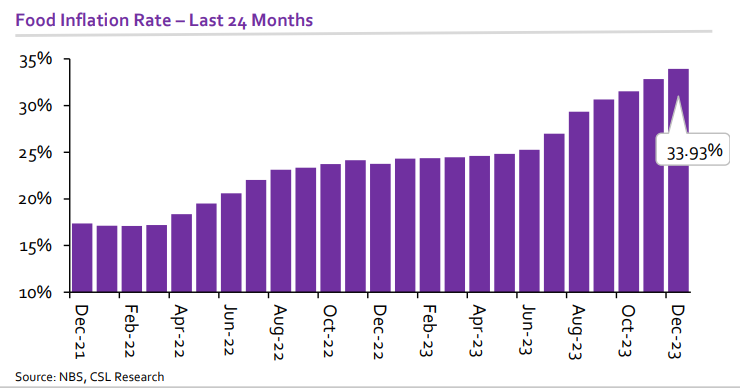
Based on news reports, the Minister of Agriculture and Food Security, Mr. Abubakar Kyari, has stated that achieving food security through agricultural development is at the core of President Bola Ahmed Tinubu’s eight-point agenda, because all the programmes on the agenda are connected to agriculture. He noted that the president is concerned about the capacity of farmers to acquire agricultural inputs and has now begun a process to accelerate access to such inputs by farmers. Food inflation jumped by 10.18ppts to 33.93% in 2023, reflecting risks like insecurity and high input costs. On the latter, Nigeria primarily relies on imports of Muriate of Potash (MOP), a crucial ingredient for blending agricultural inputs, which is sourced from Russia. However, due to the web of sanctions imposed on Russia, this essential supply chain has been disrupted.
According to the World Food Programme, 26.5 million people across the country are projected to face acute hunger in the June-August 2024 lean season. This is a significant increase from the 18.6 million food insecure people at the end of 2023. Food supply has over the years been impacted by violent conflicts, including the insurgency in the Northeast; armed banditry in the Northwest; perennial farmer– herder conflicts in the North Central and Southwest. Other factors contributing to the food insecurity situation include rising inflation which has led to increases in input costs, poor implementation of agricultural policies, rising poverty, and rising unemployment, engendering, and compounding a cost-of-living crisis, with deleterious effects on the living conditions of citizens, and their ability to access food. Climate change, in particular, the rising incidence and frequency of floods, has also continued to affect food production and the availability and affordability of food. According to the National Emergencies Management Agency [NEMA], the 2022 floods led to the destruction and washing away of over 675,000 hectares of farmland.
In a bid to stem rising food prices, President Bola Tinubu declared an immediate “State of Emergency” on food insecurity in the country. Despite this, food prices have continued to rise. Many of the issues affecting food production remain unresolved and we believe that in 2024 the government must take proactive steps to improve food production to avert a food crisis which could impact the health of the working population and further drag growth. A starting point in our view is addressing the problem of insecurity which continues to keep farmers away from their farmlands.