


January 26, 2024/FBNQuest Research
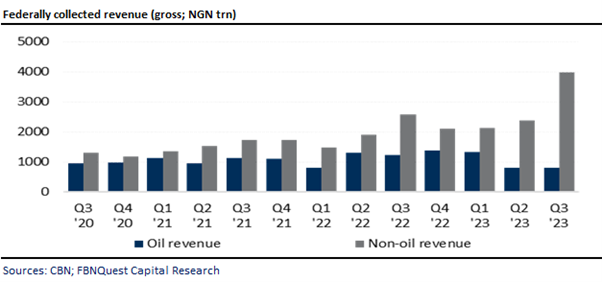
The most recent quarterly economic report from the Central Bank of Nigeria (CBN) on the federation’s revenue shows that the gross federally collected revenue increased by 50% q/q and 26% y/y to NGN4.8trn in Q3 ’23. Despite the higher revenue collections, total government receipts still fell below the pro-rata budget benchmark of NGN5.3trn. The significant rise in the gross revenue figure relative to the previous quarter was mainly due to a marked increase of 67% q/q in revenue collections from non-oil sources to NGN4.0trn. Non-oil revenue also outperformed the budget target of NGN2.9trn. Consequently, the share of non-oil revenue contribution to the total revenue collections increased to 83%, up from 75% in Q2 ’23.
The marked rise in non-oil revenue can be primarily attributed to improved collections from companies’ income tax (CIT), which more than doubled to NGN1.8trn.
Another contributory factor to the higher non-oil revenue was increases of 44% and 33% in customs & excise duties and value-added-tax (VAT) to NGN551.5bn and NGN937.9bn, respectively.
In contrast, the FGN’s independent revenue decreased modestly by -3% q/q to NGN635.0bn, well below the implied budget benchmark of NGN792.3bn.
The improved revenue take from non-oil sources were due to increased economic activities, seasonal factors, and enhanced efficiency in tax administration.
Regarding revenue from oil receipts, gross revenue from oil and gas increased slightly by +1% to NGN814.2bn. However, on a y/y basis, it fell significantly by -34 y/y and was also below the pro-rata budget benchmark of NGN2.4trn.
The slight q/q rise in oil revenue was driven by higher collections from production sharing contracts (PSC) and the 2023 interim dividend payments by NNPC Ltd.
After deductions, transfers, and additional revenue from other sources, mainly from exchange gain, the three tiers of government distributed a higher balance of NGN2.8trn compared with NGN2.2trn the previous quarter.