
March 8, 2024/FBNQuest Research
Today, we look at developments in the electricity sector. According to the United States Agency for International Development (USAID), Nigeria has the capacity to produce 12,522MW of electricity from its current power infrastructure. However, recent data from Nigerian Electricity Supply Operators suggest a peak power generation of 4019.48MW in March (vs. 4947.32MW in December 2023).The decline in energy generated is due to gas supply constraints and mechanical failures within power plants.
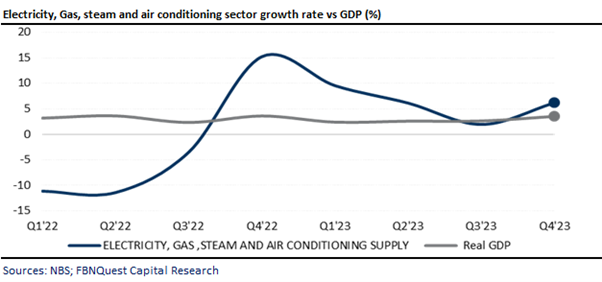
The National Bureau of Statistics (NBS) data shows that the electricity, gas, steam and air conditioning supply sector grew by +6.2% q/q in Q4’23, though -59.5% y/y lower than Q4’22. Looking at the sector’s contribution to real GDP as at Q4 ’23, we note a slight increase to 0.54% q/q, which is 1bps higher than Q4’22 and 17bps higher than Q3’23.
We believe existing challenges in the sector, which continue to impede its growth potential, are reflected in the Q4’23 data. In addition to the challenges of gas supply and weak transmission grid, poor revenue collection is also a challenge due to the low level of metering by the distribution companies, as well as non-cost reflective tariffs.
To promote efficiency of the distribution networks and electricity supply, the International Energy Agency suggests that approximately USD10bn needs to be invested in the sector.
It is estimated that about NGN1.7trn will be allocated for electricity subsidies in 2024, indicating a y/y increase of +170% compared with 2023.
Currently, electricity consumers pay an average of NGN70 per kilowatt hour, as opposed to NGN140 per kilowatt-hour, which the Distribution Companies (DisCos) believe to be the cost-reflective tariff.
According to the U.S. Energy Information Administration, Nigeria’s gas reserves are estimated to be around 206.5trn cubic feet. This positions the country as the 9th largest global reserve holder, constituting 2.6% of the total global share. Over the long term, the substantial reserve in Nigeria, coupled with investments in the sector, is anticipated to facilitate the growth of thermal power sources.