





March 12, 2024/CSL Research
News reports, citing results from a recent Cadre Harmonise assessment indicate that no less than 31.5 million Nigerians are at risk of food insecurity between June and August of 2024, with 83,846 of these individuals being internally displaced people (IDPs).
The northeastern states are anticipated to bear the brunt of the impact, particularly affecting 2.1 million individuals in Borno, 1.5 million in Yobe State, and 1.1 million in Adamawa State. This is attributed to the region being in the third phase of food and nutrition insecurity, indicating a heightened vulnerability during this period.
The Cadre Harmonisé is a tool and methodology used in West Africa to assess food and nutrition security. It is a framework developed by the Permanent Inter-State Committee for Drought Control in the Sahel (CILSS) and partners, including the Food and Agriculture Organization (FAO), the World Food Programme (WFP), and other regional and international organizations. The Cadre Harmonisé, which translates to “harmonized framework” in English, aims to harmonize and standardize food security assessments across countries in the West African region.
Food supply in Nigeria has over the years been impacted by violent conflicts, including the insurgency in the Northeast; armed banditry in the Northwest; and perennial farmer–herder conflicts in the Northcentral and Southwest.
Other factors contributing hampering food supply include rising inflation which has led to increases in input costs, poor implementation of agricultural policies, high cost of transport, rising poverty, and rising unemployment, engendering, and compounding a cost-of-living crisis, with deleterious effects on the living conditions of citizens, and their ability to access food. Also, climate change, in particular, the rising incidence and frequency of floods, has continued to affect food production and the availability and affordability of food.
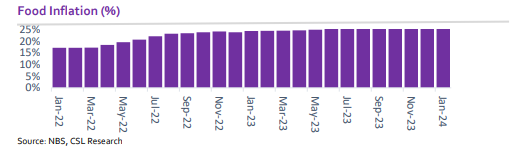
Despite government efforts, food inflation has continued to rise, up by 148 basis points in January to reach 35.41% from December 2023’s 33.93%. Considering the current situation in the country, it is anticipated that this upward trajectory will persist in the short term.
We advocate for proactive measures by the government, particularly in bolstering the country’s security infrastructure. Creating a safer environment for farmers to work in will not only boost food production but also prevent a potential food crisis which could have detrimental effects on the health of the working population and exacerbate the economic challenges facing the country.
Click here to read full PDF copy of report

