


March 19, 2024/FBNQuest Research
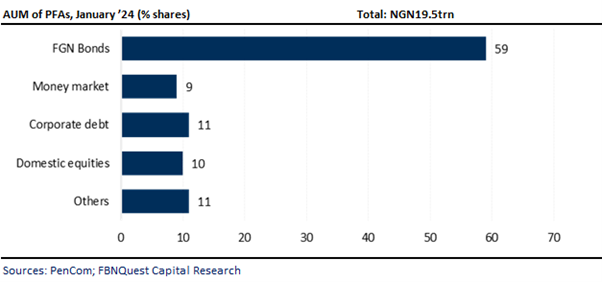
The National Pension Commission (PenCom) recently published its monthly report on Nigeria’s pension fund assets. The commission’s most recent report shows that assets under management (AUM) of the regulated pension industry increased by +6% m/m to NGN19.5trn in Jan ’24. This growth marks the strongest m/m growth rate of pension assets in recent months. On a y/y basis, the industry’s overall AUM increased significantly by +28% y/y.
The enactment of the Pension Reform (PFA) Act in 2004 was the turning point for the Nigerian pension industry. The implementation of several pension regulations, following the PFA Act of 2004 shaped the landscape of the industry.
Notably, the PRA Act 2004 introduced the Contributory Pension Scheme (CPS), an arrangement under which both the employer and employee contribute to the employee’s pension account.
Although the Pension Reform Act 2004 was abolished by the Pension Reform Act (PRA) 2014, the pension industry has continued to deliver impressive growth over the years.
Also, the pension industry has contributed positively to Nigeria’s economic growth due to its crucial role in driving savings and investments.
Despite the remarkable growth witnessed in recent years, we believe the pension industry still has the potential for significant growth given the relatively underpenetrated state of the industry.
To put into context, Nigeria’s overall pension assets to GDP ratio stands at 8.5% of 2023 GDP.
Nigeria’s ratio compares unfavourably with the 29.4% (2020) average for a group of 78 countries based on World Bank data.
Despite the introduction of the Micro Pension Scheme in 2019, which was aimed at increasing the pension participation rate and boosting inclusion in the country, particularly in the informal sector, recent data suggests that the country’s pension coverage is still low.
Nigeria’s low level of pension participation can be linked to a combination of factors, including a high level of unemployment, rising cost of living, sluggish recovery of the economy and low awareness of pension products.