

April 3, 2024/FBNQuest Research
Nigeria’s infrastructure stock falls below the internationally recognised benchmark of 70% of GDP, as set by the World Bank. The infrastructure deficit undermines the country’s economic competitiveness, contributing to higher levels of unemployment and inflation. Notably, transportation infrastructure stands out as one of the sectors most adversely affected by the deficit. Given the deficit in transportation infrastructure, the current administration has prioritised investments in rail transportation. The prioritization is due to the crucial role of rail in supporting local supply chains and promoting the ease of doing business. Today, we examine data supplied by the Nigerian Railway Corporation (NRC), published by the National Bureau of Statistics (NBS)
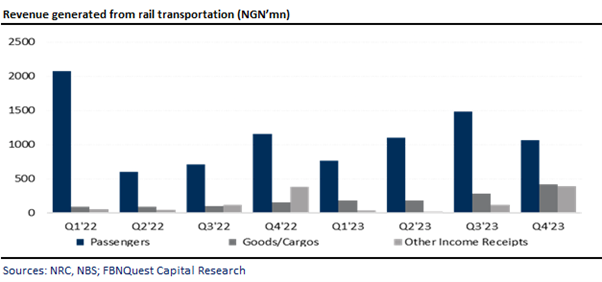
- In terms revenue generation, a total of N1.1bn was generated from passengers in Q4 ’23. This represents a -28 3% q/q and -7 5% y/y drop from the NGN1 4bn and NGN1.2bn received in Q3 ‘23 and Q4 ‘22, respectively.
- The 04’23 data also revealed a -49.7% y/y decline in the number of rail passengers to 672,198 compared with the1,337,108 passengers in Q4’22
- This decline was primarily responsible for the 26% y/y drop in passenger revenue in FY 2023.
- The persistent security concerns within railway transit systems continue to affect travel numbers despite the benefits of reduced traffic congestion and the high cost of air travel.
- However, rail travel remained a viable means of transporting goods as the cargo volume increased by +47 5% q/q and 169 2%6 y/y to 119,286 tons in 04’23.
- This translated to a 169 2% y/y rise in cargo revenue to NGN423.2m from NGN157.2m received in Q4’22.
- In addition, income from other receipts amounted to NGN393.7m. indicating a 230.3% q/q and 3 02% y/y increase.
- To tackle security challenges, the NRC intends to allocate around 10% of its total 2024 budget of NGN11.8bn to secure rail lines and ensure passengers’ safety.